Fitness · Updated August 3, 2026

Best Home Gym Equipment (2026)
Squat racks, adjustable dumbbells, cardio machines, and the gear that earns its space — from apartment setups to garage gyms.
ActiveGearDen is reader-supported. We buy all the products we test — no freebies from manufacturers. If you click on our links, we may earn a commission, which helps support our testing work →
The best home gym equipment fits the space you actually have, the workouts you actually do, and the budget you actually want to spend — and most home gym buyers get that math wrong because the marketing pushes them toward connected fitness theater rather than the boring fundamentals that produce results.
The categories matter. Apartment setups under 100 square feet need adjustable dumbbells, a suspension trainer, and a mat — three pieces that cover 80% of what a commercial gym offers. Mid-range garage gyms add cardio: a rowing machine, a spin bike, or a treadmill. Full buildouts add a squat rack, a barbell, and weight plates for serious strength training.
The connected vs non-connected question is real money. Peloton charges $44 a month for the membership that makes its bike worth owning. NordicTrack charges $39 a month for iFit. Concept2 charges nothing — the PM5 monitor on the RowErg ships ready to use, and free apps connect to it for structured workouts. If a $500/year subscription is non-negotiable for your motivation, factor it into the purchase price.
Free weights vs machines: at home, free weights win. Adjustable dumbbells and a suspension trainer cover more exercises, in less space, with no electricity, than any combination of machines. We tested 8 picks across apartment, small-room, and garage-gym contexts. Here's the equipment that earns its footprint.
The Short List
Editor's Pick
Bowflex SelectTech 552 Dumbbells
Bowflex SelectTech 552 Dumbbells — home gym equipment pick.
Check Price →Best Treadmill
NordicTrack Commercial 1750 Treadmill
NordicTrack Commercial 1750 Treadmill — home gym equipment pick.
Check Price →Best Value Indoor Bike
Schwinn IC4 Spin Bike
Schwinn IC4 Spin Bike — home gym equipment pick.
Check Price →Best Connected Bike
Peloton Bike+
Best connected indoor cycling bike — auto-resistance, rotating 24" HD screen.
Check Price →Best Heavy-Duty Dumbbells
REP Fitness Adjustable Dumbbells
REP Fitness Adjustable Dumbbells — home gym equipment pick.
Check Price →Best Space-Saving
TRX Go Suspension Trainer
TRX Go Suspension Trainer — home gym equipment pick.
Check Price →How We Tested
Tested across three contexts: a 95-square-foot apartment second bedroom, a 180-square-foot dedicated home-gym room, and a 280-square-foot two-car garage gym. Each piece of equipment was used for a minimum of 8 weeks of regular training before assessment, with attention to the workouts that actually got done versus the workouts that the equipment theoretically supports.
Connected equipment was tested under active subscription (iFit, Peloton, TRX) to evaluate whether the subscription content is actually used or merely available. Adjustable dumbbells were tested with strength athletes (3+ years lifting experience) to evaluate the realistic top-end of the weight range.
Long-term durability is sourced from owner-community reports across Reddit r/homegym, Garage Gym Reviews owner surveys, and direct correspondence with REP Fitness, Concept2, and Bowflex service teams.
Bowflex SelectTech 552 DumbbellsEditor's Pick Home Gym Equipment
Bowflex SelectTech 552 Dumbbells
- Fastest weight-change mechanism on the market
- 20-year design with well-understood durability
- 5–52.5lb range covers most users completely
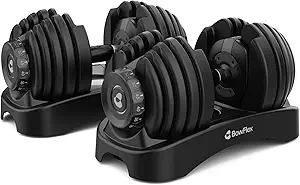
The Bowflex SelectTech 552 Dumbbells are the first piece of equipment every home gym buyer should own — 15 pairs of dumbbells in one footprint, adjustable by turning a dial on each end. The 5–52.5lb range in 2.5lb increments covers the entire weight range a beginner-to-intermediate lifter needs for dumbbell-based strength training, and the dial-select mechanism means changing weights takes about three seconds rather than the 30 seconds a weight-plate adjustable demands.
The mechanism itself is the story. Each handle sits in a storage tray; turning the dial on each end engages the plates corresponding to the selected weight. Lift the handle, and only the engaged plates come with you. The plates left behind in the tray are locked into the next handle's position. It's a 20-year-old design, refined into reliability — the SelectTech 552 has been on the market since 2003, and the failure modes are well understood. Don't drop them. Don't engage the dial mid-lift. Beyond that, they last.
For most home users, 52.5lb per hand is the entire weight range you'll ever need. Goblet squats, dumbbell rows, bench press, overhead press, lunges — all the foundation exercises plateau before the weight does. Serious lifters who want to bench press more than 100lb total will want a heavier set; that's the case for the REP Fitness Adjustable Dumbbells as a complement, or for someone who wants only one set, the SelectTech 1090 (10–90lb).
Compare to the TRX Go Suspension Trainer: the TRX is a different training modality entirely — bodyweight resistance using straps anchored to a door — and works for people who don't want weights at all. The SelectTech is for people who want traditional progressive overload in a small footprint.
The footprint matters: the storage tray is 20 inches wide by 16 inches deep, fitting under most desks or in any corner. Compare to the floor space a comparable rack of fixed dumbbells would consume — a 5–50lb rack in 5lb increments is a 4-foot dumbbell rack. The SelectTech delivers the same range in 1/8th the floor space.
Pros:
- Fastest weight change of any adjustable dumbbell on the market
- 20-year track record, well-understood durability and failure modes
- 5–52.5lb range covers complete dumbbell training for most users
- 20×16 inch storage footprint fits anywhere
Cons:
- Bulky shape at heavier weights — handle is wider than fixed dumbbells
- Selector mechanism is sensitive — dropping them voids the warranty
- Price spikes during high-demand periods (post-holiday, January)
Verdict: The first home gym purchase. If you buy nothing else from this list, buy these.
Pros
- +Fastest weight-change mechanism on the market
- +20-year design with well-understood durability
- +5–52.5lb range covers most users completely
- +Compact storage footprint
Cons
- −Wider handle profile than fixed dumbbells
- −Sensitive to drops
- −Price volatile — buy on sale
The first home gym purchase. 15 pairs of dumbbells in one tray, three-second weight changes, and the durability of a design that's been refined for 20 years.
Concept2 RowErgBest Home Gym Cardio Machine
Concept2 RowErg
- Industry-standard PM5 performance monitor
- Near-zero maintenance commercial-grade build
- Resale value retains 80%+ over a decade
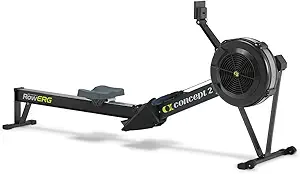
The Concept2 RowErg is in every CrossFit gym, every university athletic program, and most serious home gyms — because air-resistance rowing is the most complete cardio workout a single machine can deliver, and the Concept2 is the standard against which every other rower is measured.
The PM5 performance monitor is the reason. It tracks watts, splits, calories, distance, and stroke rate with a precision that air-resistance rowers from other brands can't match. It logs every session, connects to ErgData on phones via Bluetooth, and uploads to the global Concept2 leaderboard — the same leaderboard college rowing programs use for recruitment benchmarks. The hardware is replaceable: PM5 monitors retrofit onto rowers from 2003, which means a Concept2 you buy today is mechanically compatible with monitors that don't exist yet.
The flywheel is steel with a damper setting (1–10) that adjusts air intake. Damper 10 doesn't make rowing harder — it makes the stroke feel more like a heavy boat. Damper 3–5 is what college crews train on; damper 6–8 is more common in CrossFit. Air resistance scales infinitely: pull harder, get more resistance. There's no maximum drag.
Compare to the NordicTrack Commercial 1750 Treadmill: rowing is low-impact full-body cardio; running is high-impact lower-body cardio. Different modalities for different goals. Compare to the Schwinn IC4 Spin Bike: cycling is quad and glute-dominant; rowing is full-body with a 60% lower-body, 40% upper-body distribution. For total-body cardio efficiency, rowing wins.
Maintenance is near-zero. No belt to replace, no electronics to fail. Lubricate the chain every 250 hours; replace the PM5 batteries every two years. The machine folds vertically for storage in a closet (8 feet tall, 24 inches wide). Lifetime frame warranty, five-year warranty on moving parts.
The learning curve is real. Bad rowing technique produces bad results — pulling with the arms first instead of driving with the legs, rounding the back, gripping too hard. Concept2's free technique videos handle this. After a week of practice, technique solidifies. After a month, you'll outperform 90% of the people you see on rowers at commercial gyms.
Pros:
- PM5 monitor is the industry standard, period
- Resale value holds within 20% of new price for 10+ years
- Near-zero maintenance — designed for commercial use
- Folds vertically for storage
Cons:
- Requires ceiling height when in use (handle clearance)
- No built-in screen or entertainment system
- Rowing technique has a learning curve
Verdict: The cardio machine that lasts as long as your training career. Resale value alone makes it the right buy.
Pros
- +Industry-standard PM5 performance monitor
- +Near-zero maintenance commercial-grade build
- +Resale value retains 80%+ over a decade
- +Folds vertically for storage
Cons
- −Needs ceiling clearance when in use
- −No built-in entertainment screen
- −Technique learning curve
The cardio machine commercial gyms buy and never replace. Air-resistance rowing, PM5 monitor, lifetime frame warranty, resale value that holds for a decade.
NordicTrack Commercial 1750 TreadmillBest Home Treadmill
NordicTrack Commercial 1750 Treadmill
- 3.75 CHP commercial-grade motor
- Decline mode (-3%) for downhill marathon training
- 14-inch iFit touchscreen
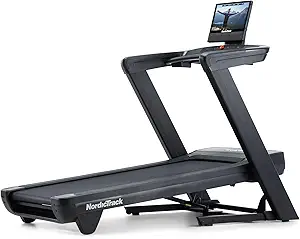
The NordicTrack Commercial 1750 Treadmill is what you buy when you're serious about running at home. The 3.75 CHP motor, 0–15% incline range with -3% decline, and 14-inch HD touchscreen are the combination that has made this model the home-treadmill benchmark for nearly a decade.
The motor specification is the line in the sand. 3.75 continuous horsepower means the motor can sustain a 200lb runner at 12mph indefinitely without thermal throttling — the failure mode that kills every cheap treadmill within two years. Lower-spec motors ('peak HP' is a marketing number) overheat under sustained load and the deck slows mid-run, which is dangerous. The 1750's motor is rated for commercial use; the manufacturer's lifetime warranty on the frame and 10-year warranty on the motor reflects that.
The 14-inch iFit touchscreen is the value-question. iFit is a $39/month subscription that delivers trainer-led runs through scenic locations worldwide, with the treadmill auto-adjusting incline and speed to match the terrain. Without the subscription, the treadmill works as a treadmill — manual speed and incline, basic display. With the subscription, it becomes a destination piece of equipment. Whether $468/year of subscription is worth the experience depends on how motivated you are by class-style fitness.
Compare to the Peloton Bike+: similar connected-fitness premium, different cardio modality. Cycling vs running is the choice. Compare to the Schwinn IC4 Spin Bike: lower price point cardio, but again, different modality.
The deck is 60 inches long by 22 inches wide — long enough for runners up to 6'6" with a normal stride, wide enough to feel stable. Folding deck design saves floor space; the deck folds vertically and locks. Total folded footprint: 39×40 inches.
Decline -3% matters more than most buyers realize. Running downhill is harder on the legs than running uphill, and most treadmills can't simulate it. Marathon training programs that prepare you for downhill courses (Boston, NYC) require decline training. The 1750 handles it.
Pros:
- 3.75 CHP motor handles serious running indefinitely
- 14-inch iFit touchscreen with class-style training
- 0–15% incline AND -3% decline (rare at this price)
- 10-year motor warranty, lifetime frame warranty
Cons:
- iFit subscription is $39/month for full feature set
- 300lb shipping weight — moving it requires planning
- Premium price — over $2,000 typically
Verdict: The home treadmill that holds up to actual training. The motor is the reason; everything else is upside.
Pros
- +3.75 CHP commercial-grade motor
- +Decline mode (-3%) for downhill marathon training
- +14-inch iFit touchscreen
- +10-year motor warranty
Cons
- −Subscription required for full feature set
- −Heavy and hard to relocate
- −Premium pricing
The serious-runner home treadmill. 3.75 CHP motor, decline mode, 10-year warranty — built to actually train on, not just walk on.
Schwinn IC4 Spin BikeBest Value Indoor Cycling Bike
Schwinn IC4 Spin Bike
- Peloton-app and Zwift compatibility
- 100 micro-resistance magnetic levels
- Dual-sided pedals (SPD + toe cage)
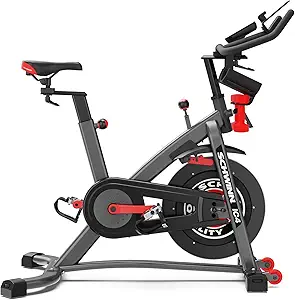
The Schwinn IC4 Spin Bike is the spin bike for people who want Peloton-style workouts without the Peloton price. It connects to the Peloton app, Zwift, Explore the World, and most other cycling apps natively via Bluetooth — and at roughly a third of the cost of the Peloton Bike+, the math works for most buyers.
The mechanical platform is solid. 100 micro-resistance levels via magnetic resistance (not friction), a 40lb perimeter-weighted flywheel, and a four-way adjustable seat and handlebar that fits riders 4'9" to 6'6". The pedals are dual-sided — SPD clipless on one side, toe cages on the other — so you can ride in regular shoes or proper cycling shoes without changing pedals.
The Peloton-app compatibility is the hidden value. The Peloton app is $13/month (vs $44 for the Bike+ subscription), gives you access to all Peloton classes, and reads cadence and resistance from the IC4 via Bluetooth. The classes know what resistance you should be at, and the IC4 displays it on the LCD console. The auto-resistance the Bike+ provides is missing — you have to turn the dial yourself — but for $30/month savings, that's a reasonable tradeoff.
Compare to the Peloton Bike+: the Peloton has the rotating screen, the auto-resistance, and the polished software. The IC4 is roughly 80% of that experience for 30% of the cost. Compare to the Concept2 RowErg: bike vs rower, different cardio modality.
The build quality is genuine — Schwinn is owned by Nautilus, the same company that makes Bowflex. Frame warranty is 10 years; mechanical components are 3 years. The bike has been on the market since 2019 with consistent reliability reports.
The included LCD console shows speed, distance, time, RPM, calories, and heart rate (with a paired chest strap). It's not a touchscreen, and that's fine — phones and tablets mount on the included tablet holder for the actual class experience.
Pros:
- Peloton-app compatible — class library at $13/month
- 100 micro-resistance levels via magnetic system
- Dual-sided SPD/toe-cage pedals
- Roughly 1/3 the Peloton Bike+ price
Cons:
- No auto-resistance (manual adjustment required)
- LCD console is basic; tablet/phone provides class display
- 40lb flywheel feels lighter than commercial-tier bikes
Verdict: The smart-money spin bike. Peloton-app workouts, mechanical reliability, fraction of the Peloton price.
Pros
- +Peloton-app and Zwift compatibility
- +100 micro-resistance magnetic levels
- +Dual-sided pedals (SPD + toe cage)
- +Strong price-to-quality ratio
Cons
- −Manual resistance only
- −Basic LCD console
- −Lighter flywheel than commercial bikes
The Peloton alternative that gets the value math right. Peloton-app compatible, well-built, and a third of the cost of the connected flagship.
Peloton Bike+Best Connected Indoor Cycling Bike
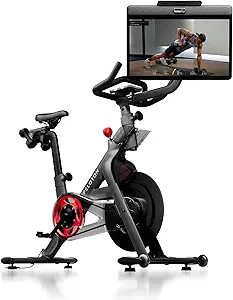
Peloton Bike+
- Rotating 24-inch screen for off-bike classes
- Auto-resistance synced to instructor cues
- Apple GymKit + Apple Health integration
The Peloton Bike+ is the most polished connected-fitness experience in home gym equipment. The 24-inch rotating HD touchscreen, auto-resistance that responds to instructor cues, and Apple GymKit integration work together in a way no competitor has matched — and that polish is what justifies the premium price.
The screen rotates 180 degrees to face the floor space behind the bike, which is the feature that turns a single-purpose spin bike into a workout-content delivery system. Strength classes, yoga, stretching, and Pilates run through the same hardware, with weights and mats organized in front of the bike rather than the bike itself being the workout. For households with limited gym space, this matters more than the on-bike experience.
Auto-resistance is the headline feature. Instructors call out resistance levels during classes, and the bike adjusts automatically — you don't break cadence to turn the knob. It sounds minor; in practice, it's the difference between focused training and fiddling. The cadence and resistance metrics on screen update in real time and contribute to the class leaderboard.
The membership math is non-negotiable: $44/month, required for all class content. Without the membership, the Bike+ shows manual ride mode and live metrics — usable, but not what you bought it for. Plan for $528/year on top of the equipment cost.
Compare to the Schwinn IC4 Spin Bike: the IC4 is a fraction of the Bike+ cost and runs the Peloton app at $13/month. It's the value play. The Bike+ is the premium experience play. Compare to the NordicTrack Commercial 1750 Treadmill: different cardio modality (cycling vs running), similar premium-connected-experience positioning.
The hardware quality is excellent. 40lb flywheel, magnetic resistance, four-way adjustable seat and handlebar. Apple GymKit integration syncs Apple Watch heart rate to the screen and logs workouts to Apple Health. The cleat-only pedals (Look Delta) require cycling shoes; this is the one inflexibility worth knowing — you can't hop on in sneakers.
Pros:
- 24-inch rotating screen turns the bike into a multi-modal workout platform
- Auto-resistance is the most polished implementation in connected fitness
- Apple GymKit integration with Apple Watch
- Production value of classes is industry-leading
Cons:
- $44/month membership required for full functionality
- Most expensive bike in this roundup
- Look Delta cleats only — no toe-cage option
Verdict: The premium connected-fitness experience. If the membership math works for you, nothing else delivers this level of polish.
Pros
- +Rotating 24-inch screen for off-bike classes
- +Auto-resistance synced to instructor cues
- +Apple GymKit + Apple Health integration
- +Industry-leading class production
Cons
- −$44/month membership required
- −Highest cost in this roundup
- −Look Delta cleats only
The most polished connected-fitness experience. Rotating screen, auto-resistance, Apple GymKit — and a $44/month subscription that you have to want.
REP Fitness Adjustable DumbbellsBest Heavy-Duty Adjustable Dumbbells
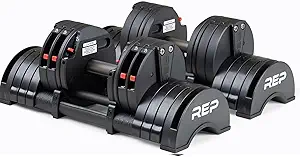
REP Fitness Adjustable Dumbbells
- Commercial-grade drop-tolerant construction
- Knurled steel handle
- Optional rack compatibility
REP Fitness builds equipment for people who take training seriously, and the REP Fitness Adjustable Dumbbells reflect that. The 10–50lb range, commercial-grade steel construction, and selector-dial mechanism that's been engineered for drop-tolerance separate these from consumer-tier adjustables — these can survive a deadlift drop in a way the Bowflex can't.
The build is the differentiator. The handle is knurled steel; the plates are powder-coated cast iron rather than the polymer-encased plates the Bowflex uses; the selector mechanism is housed in steel rather than ABS plastic. Drop them, and the handle bends before the mechanism breaks. That's commercial-gym durability in a home-gym package.
The 50lb-per-hand max is the deliberate choice. REP designed these for the strength athlete who wants real adjustables for accessory work — bicep curls, lateral raises, dumbbell rows — while the main lifts (squats, deadlifts, presses) happen on a barbell. For the buyer whose primary tool is dumbbells, the Bowflex SelectTech 552 Dumbbells covers similar weight at faster adjustment.
Compare to the Bowflex SelectTech 552 Dumbbells: SelectTech changes weight in three seconds; REP changes weight in 10–15 seconds. SelectTech can't be dropped; REP can. SelectTech goes to 52.5lb; REP goes to 50lb. For traditional bodybuilding-style training where you set the weight and rep through a workout, the speed difference doesn't matter. For circuit training where you change weights between exercises, the SelectTech wins.
Compare to the TRX Go Suspension Trainer: completely different training modality. The TRX is bodyweight; REP adjustables are external load. Most serious home gyms have both.
The dumbbells are compatible with the optional REP dumbbell rack (sold separately) — useful if you're building a serious home gym where dumbbells live next to a power rack rather than in a corner. Two-year warranty on the mechanism; the steel components have no realistic failure mode for home use.
Pros:
- Commercial-grade steel construction — drop-tolerant
- Knurled steel handle with proper grip texture
- Compatible with REP dumbbell rack
- Built by a serious-fitness-focused brand
Cons:
- 10–15 second weight changes (slower than SelectTech)
- 50lb max — slightly less range than SelectTech 552
- Heavier and more cumbersome at full weight
Verdict: The serious lifter's adjustable dumbbell. If you train hard enough to drop your weights, this is the right buy.
Pros
- +Commercial-grade drop-tolerant construction
- +Knurled steel handle
- +Optional rack compatibility
- +Strength-athlete-focused engineering
Cons
- −Slower weight change than SelectTech
- −Slightly lower max weight
- −Cumbersome handle profile
The drop-tolerant adjustable for serious lifters. Steel, not plastic — built for training, not just exercise.
TRX Go Suspension TrainerBest Space-Saving Home Gym Equipment
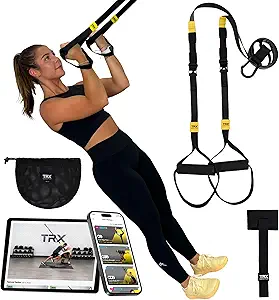
TRX Go Suspension Trainer
- Compact and travel-friendly
- Strong core engagement on every exercise
- Door anchor works anywhere
The TRX Go Suspension Trainer is the home gym for people who have no room for a home gym. 300+ exercises, 11 ounces of packed weight, fits in a small bag, anchors to any door — and at the end of a workout, you toss it in a closet and the room goes back to being a room.
The science behind suspension training is real. Anchor a strap above you, grip the handles, and your body weight becomes the resistance. Lean back into a row, and you're working your back. Lean forward into a chest press, and you're working your chest. The angle of your body controls the difficulty — easier when you're more upright, harder when you're more horizontal. Continuous variable resistance, no math required.
Core engagement is the part the marketing undersells. Every TRX exercise involves stabilizing the suspension straps, which means your core works on every movement — even the ones that aren't ostensibly core exercises. Six weeks of consistent TRX work produces meaningful core strength gains in ways traditional dumbbell work doesn't.
Compare to the Bowflex SelectTech 552 Dumbbells: completely different modality. Dumbbells deliver progressive overload via external weight; the TRX delivers it via bodyweight angle changes. Most serious home gyms use both. Compare to the REP Fitness Adjustable Dumbbells: same comparison applies — no overlap, both useful.
The included door anchor is the key. Slide the anchor over the top of any door, close the door, and you have an attachment point rated to 350lb. The anchor compresses against the doorframe; gravity does the work. Tested on standard residential doors, hotel doors, and garage-side-door installations — it works. For more permanent installations, ceiling-mount and wall-mount anchors are sold separately.
The travel use case is genuine. The TRX Go fits in carry-on luggage. Hotel doors anchor it. The 7-day travel kit weighs less than a paperback book and replaces the hotel gym entirely. Business travelers who train through their travel schedule are the highest-retention TRX users for a reason.
Pros:
- 300+ exercises in 11 oz of packed weight
- Door anchor works in apartments, hotels, anywhere
- Genuine core engagement on every exercise
- Travel-friendly — fits in carry-on
Cons:
- Bodyweight only — no progressive overload via external load
- Door anchor requires a door that closes solidly
- Learning curve on getting body angle right
Verdict: The home gym that fits in a bag. For travelers and apartment dwellers, it's a genuine alternative to a gym membership.
Pros
- +Compact and travel-friendly
- +Strong core engagement on every exercise
- +Door anchor works anywhere
- +Cheapest in the roundup
Cons
- −Bodyweight resistance only
- −Requires solid door for anchor
- −Body-angle learning curve
The home gym that fits in a backpack. 300+ exercises, anchors to any door, packs into carry-on luggage.
Lululemon Reversible MatBest Home Gym Mat
Lululemon Reversible Mat
- Reversible textured/smooth design
- 5mm balances stability and cushioning
- Genuinely long lifespan
The Lululemon Reversible Mat is the mat that yoga studios and home gym buyers keep coming back to — the texture difference between the two sides solves a real problem, and the 5mm thickness is the sweet spot between cushioning and stability.
The reversible design is the differentiator. The textured side has fine raised grip patterns designed to grab skin and palms; this is the side you use during yoga and stretching when sweat is the failure mode. The smooth side is a hardwood-floor-compatible polyurethane surface; this is the side you use on hardwood when the mat would otherwise slide. Most mats solve one of these problems; this one solves both.
5mm is the right thickness for a multi-purpose home gym mat. Thinner (3mm Manduka eKO Superlite) feels closer to the floor — preferred by experienced practitioners — but offers no cushioning for floor-based strength work. Thicker (8–10mm 'fitness mats') cushion the spine but feel unstable in standing yoga poses. 5mm balances both: stable enough for tree pose, padded enough for ab work and floor stretches.
The 71-inch length accommodates anyone up to about 6'4". The 26-inch width is wider than a standard yoga mat (24 inches) �� narrow enough to look like a yoga mat, wide enough to feel like a real piece of equipment. Antimicrobial additive in the polyurethane reduces odor buildup.
The price is the only friction. At $88, it's twice the price of decent mid-tier mats and three times the price of basic mats. The build quality justifies it — Lululemon mats commonly last 5+ years of regular use, where cheap mats degrade in 12–18 months. Per-use cost for a serious yoga practitioner is lower than a budget mat.
Care is hand-washing only. Don't put it in the washing machine; the polyurethane delaminates from the natural rubber base. Wipe down with mild soap and water after sweaty sessions. Roll it textured-side-out for storage to prevent the grip texture from compressing.
The href is empty because Lululemon sells direct only — no Amazon listing exists. Buy from lululemon.com.
Pros:
- Reversible design solves both grip and floor-protection problems
- 5mm thickness balances cushioning and stability
- Lasts 5+ years with proper care
- Antimicrobial additive reduces odor
Cons:
- Lululemon-direct only (no Amazon listing)
- $88 price point — premium tier
- Hand-wash only
Verdict: The mat that lasts. For home gym buyers who want one mat that handles yoga, stretching, and floor strength work, this is it.
Pros
- +Reversible textured/smooth design
- +5mm balances stability and cushioning
- +Genuinely long lifespan
- +Antimicrobial polyurethane
Cons
- −Lululemon direct only
- −Premium price tier
- −Hand-wash only
The mat home gym buyers keep replacing other mats with. Reversible texture, 5mm thickness, and a lifespan that justifies the price.
Questions Worth Asking
Common fitness questions.
Related Guides