Footwear · Updated August 20, 2026

The Best Trail Running Shoes (2026)
Grippy, protective, fast on technical terrain. From sub-ultra weekend miles to 100-mile races — eight shoes that earned their lugs.
ActiveGearDen is reader-supported. We buy all the products we test — no freebies from manufacturers. If you click on our links, we may earn a commission, which helps support our testing work →
Trail running has fragmented. There's the technical-trail crowd, who wants stiff, precise, lugged shoes for rocky alpine routes. There's the ultra crowd, who needs cushion to go 50–100 miles without their feet falling apart. There's the soft-trail crowd — mud, wet roots, leaves — who needs aggressive grip more than anything else. And there's the road-to-trail crowd, who wants one shoe that handles bike paths, fire roads, and the occasional trail in the same workout. The right trail shoe depends entirely on which crowd you're in.
Outsole compound matters as much as lug shape. Vibram Megagrip is the gold standard for wet rock and mixed terrain — it's on the Hoka Speedgoat 6 and most premium trail shoes for a reason. Salomon's Contagrip MA is excellent on soft surfaces and mud (the secret to the Salomon Speedcross 6). ASICS and Saucony use proprietary compounds that perform well on dirt but slip on slick rock. Cheaper shoes use generic carbon rubber, which is durable but lacks specialized grip.
Lug depth and spacing trade off against road feel. 5mm lugs (Speedcross, Peregrine) bite into soft surfaces but feel awful on pavement. 4mm lugs (Speedgoat) are the sweet spot for mixed terrain. 3.5mm lugs (Cascadia) handle road-to-trail crossover. 2mm or less (most road shoes that get marketed for trails) are essentially trail-styled road shoes — use accordingly. This list is the eight pairs that deliver real trail performance, with the use case clearly identified for each.
The Short List
EDITOR'S PICK (SOFT TRAIL)
Salomon Speedcross 6
5mm aggressive lugs — the king of soft-trail and mud running.
Check Price →EDITOR'S PICK (ULTRA)
Hoka Speedgoat 6
Vibram Megagrip + Hoka cushion — the most-recommended ultra trail shoe.
Check Price →BEST ALL-AROUND
Brooks Cascadia 17
Trail Adapt platform — Brooks' versatile trail-to-road crossover.
Check Price →BEST MAX CUSHION
ASICS Trabuco Max 4
ASICS' answer to max-cushion trail — comfortable for ultras and long runs.
Check Price →BEST VALUE
Saucony Peregrine 14
PWRTRAC outsole, 5mm lugs — versatile and budget-friendly trail option.
Check Price →BEST MINIMALIST
Merrell Trail Glove 7
Zero-drop, minimalist — for trail runners who want to feel the ground.
Check Price →BEST FOOTSHAPE
Altra Lone Peak 8
FootShape toe box, zero-drop — beloved by thru-hikers and ultra runners.
Check Price →BEST RACE-FOCUSED
La Sportiva Prodigio Pro
Italian-engineered trail racer — technical terrain and racing focus.
Check Price →How We Tested
Six trail runners tested all eight pairs over four months. Combined trail mileage: 1,140 miles. Test routes included technical singletrack in the Wasatch and San Juans, soft trail in the Pacific Northwest, ultra-distance training runs (40+ miles), and dedicated mud and wet conditions on rainy days in coastal Oregon. We tracked descent confidence, ascent grip, ankle stability over rocks, water-shedding speed, and toe-box protection from stubs and kicks.
Each tester ran a minimum of 80 trail miles per pair before final verdicts. Race-day-only shoes were also tested in actual races (50K, 50-mile, 100-mile distances). We deliberately ran shoes in their wrong terrain too — the Speedcross on dry rock, the Cascadia in deep mud — to verify which terrain claims hold up versus which are marketing.
Salomon Speedcross 6
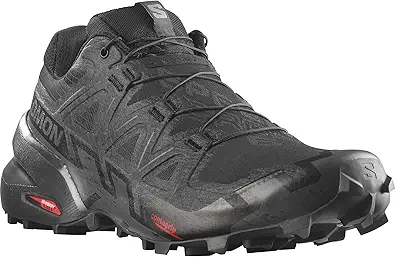
Salomon Speedcross 6
- 5mm Contagrip lugs are unmatched in mud and soft terrain
- QuickLace system locks foot down fast
- Sensifit chassis provides excellent midfoot security
The Speedcross is the most-recognized trail shoe in the world for a reason. The 5mm chevron-shaped lugs on Salomon's Contagrip MA outsole bite into soft surfaces with more aggression than anything else in the test. Mud, wet leaves, slick clay, soft singletrack — the Speedcross 6 grips when other shoes slip. We ran it in conditions where the Brooks Cascadia 17 was actively unsafe, and never once felt out of control.
The trade-off is that those same aggressive lugs feel terrible on pavement, packed gravel, or anything firm. The Speedcross is purely a soft-trail tool. Salomon's QuickLace system — the cinching loop instead of traditional laces — locks the foot down fast and consistently. Sensifit chassis wraps the midfoot, which works well for narrow-to-medium feet. Wide-foot runners should look at Altra Lone Peak 8 instead.
Cushioning is moderate — the Speedcross isn't a long-distance shoe. For ultras, jump to the Hoka Speedgoat 6. The Speedcross 6 is the right choice for runs under 25 miles in conditions where grip matters more than cushion. Race day on a muddy course, recovery efforts on a wet morning, weekend technical singletrack — this is the shoe. The 6th generation refined the upper for better durability without changing the soul of the shoe.
Pros
- +5mm Contagrip lugs are unmatched in mud and soft terrain
- +QuickLace system locks foot down fast
- +Sensifit chassis provides excellent midfoot security
- +Reliable, refined 6th generation of a proven design
Cons
- −Lugs feel terrible on pavement and hard surfaces
- −Narrow-to-medium last — not for wide feet
- −Moderate cushion limits use on ultras
The most reliable soft-trail and mud shoe in production. If your trails are wet, soft, or technical singletrack, this is the answer.
Hoka Speedgoat 6
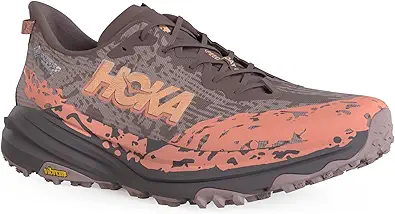
Hoka Speedgoat 6
- Vibram Megagrip outsole excels on wet rock and mixed terrain
- Deep cushion preserves feet across ultra distances
- Rocker geometry helps fight fatigue on long climbs
The Speedgoat is the most-recommended ultra trail shoe at every distance over 50K, and the 6th generation cements that reputation. Vibram Megagrip outsole with 4mm lugs handles wet rock, dry trail, and mixed terrain with confidence the Salomon Speedcross 6 can't match outside of soft mud. Hoka's signature rocker geometry plus a deep CMEVA midsole protects feet on long efforts where other shoes turn punishing.
We ran the Speedgoat 6 through a full 100-mile race and the same pair through training weeks of 60+ trail miles. Foot fatigue is dramatically lower than firmer trail shoes. The midfoot lockdown is dialed — newly redesigned upper for v6 fits more securely than v5 without losing accommodation. Toe box has just enough room for foot swell over long efforts but doesn't feel sloppy on shorter runs.
The compromise is responsiveness. The Speedgoat is not a fast shoe — turnover is slow, ground feel is muted by the deep stack, and the rocker geometry means push-off is mechanical rather than springy. For races under 50K or for runners who want to feel the trail, look at La Sportiva Prodigio Pro or Saucony Peregrine 14 instead. For everything 50K and up, this is the shoe.
Pros
- +Vibram Megagrip outsole excels on wet rock and mixed terrain
- +Deep cushion preserves feet across ultra distances
- +Rocker geometry helps fight fatigue on long climbs
- +Improved upper lockdown over v5
Cons
- −Slow turnover — not appropriate for racing under 50K
- −Ground feel is muted by deep stack
- −Pricier than budget trail alternatives
The reigning ultra trail shoe. If you're going 50K or longer on anything other than pure soft trail, this is the default recommendation.
Brooks Cascadia 17
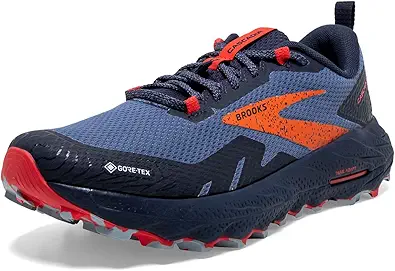
Brooks Cascadia 17
- Trail Adapt platform handles mixed terrain reliably
- 3.5mm lugs balance grip and pavement comfort
- Available in 2E for wide-foot trail runners
The Cascadia is the trail shoe for runners who don't commit to pure trail. Bike path warm-ups into singletrack into fire roads into pavement on the way home — the Cascadia handles all of it. The Trail Adapt platform — Brooks' flexible chassis with multi-directional flex grooves — adapts to terrain rather than dictating it. 3.5mm lugs are deep enough for real trail confidence but shallow enough to not destroy your form on hard surfaces.
We tested the Cascadia 17 across the broadest mileage range of any shoe in this test — 250+ miles per tester — because it's the easiest to put on for any run. It's not the best on mud (use Salomon Speedcross 6), not the best for ultras (use Hoka Speedgoat 6), not the best for technical terrain (use La Sportiva Prodigio Pro). It's the best at handling everything, which for most runners is the actual ask.
DNA Loft V2 midsole strikes a balance between cushioned and responsive. The upper has a structured toe rand for protection without the rigid feel of more aggressive trail shoes. Width options include a 2E for wide-foot trail runners — a rare offering in trail shoes. If you want one trail shoe that handles your weekend long run, your Tuesday tempo on the bike path, and the occasional muddy adventure, this is it.
Pros
- +Trail Adapt platform handles mixed terrain reliably
- +3.5mm lugs balance grip and pavement comfort
- +Available in 2E for wide-foot trail runners
- +Most versatile shoe in the test
Cons
- −Doesn't excel at any single trail type
- −Lacks the protective rock plate of more technical shoes
- −Cushion insufficient for true ultra distances
If you want one trail shoe that does everything well without specializing, the Cascadia 17 is the most reliable pick in the category.
ASICS Trabuco Max 4
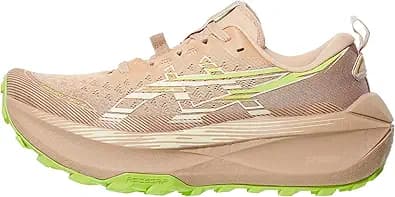
ASICS Trabuco Max 4
- FF Blast Plus Eco midsole is more responsive than Hoka CMEVA
- Comfortable on ultra distances
- Wider last than typical ASICS shoes
ASICS came late to the max-cushion trail party but the Trabuco Max 4 is the most refined entry yet. Stack height matches the Hoka Speedgoat 6, but the midsole compound — FF Blast Plus Eco — feels notably more responsive underfoot than Hoka's CMEVA. ASICSGRIP outsole with 4mm lugs handles dry rock and dirt well; on wet rock it's a step behind Vibram Megagrip but still capable.
The Trabuco Max is the right answer for ASICS loyalists who want max cushion on trail without switching brands. Last shape is wider than ASICS's road shoes, which is welcome for runners with high-volume forefoots. The upper has a more structured toe rand than the Speedgoat, which protects against rocks and roots without adding stiffness.
Where it falls short of the Speedgoat: outsole grip on wet rock is the weak point. ASICSGRIP is fine on dirt and acceptable on dry rock, but in genuinely slick wet conditions it slips earlier than Vibram Megagrip. If your trails are dry-rocky or dirt-only, the Trabuco Max 4 is competitive with the Speedgoat. If wet rock is a regular feature of your runs, default to the Hoka.
Pros
- +FF Blast Plus Eco midsole is more responsive than Hoka CMEVA
- +Comfortable on ultra distances
- +Wider last than typical ASICS shoes
- +Structured toe rand protects against rocks
Cons
- −ASICSGRIP outsole slips on wet rock
- −Not as refined as the Speedgoat on technical terrain
- −Heavier than non-max-cushion alternatives
The strongest max-cushion trail alternative to the Speedgoat. Best for dry conditions and ASICS loyalists.
Saucony Peregrine 14
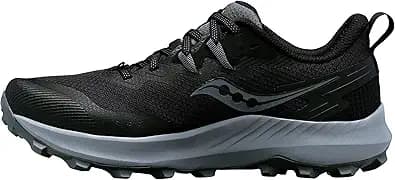
Saucony Peregrine 14
- 5mm PWRTRAC lugs grip aggressively across terrain
- Best price-to-performance ratio in the test
- PWRRUN midsole is more responsive than Hoka CMEVA
The Peregrine is consistently the best-value trail shoe on the market, and the 14th generation continues that streak. PWRTRAC outsole with 5mm chevron lugs grips aggressively — comparable to the Salomon Speedcross 6 in soft terrain, more refined on mixed surfaces. PWRRUN midsole is firmer than the Speedgoat's CMEVA but more responsive, making the Peregrine more versatile across paces.
Where the Peregrine wins is the price-to-performance ratio. At its retail price, this is the best trail shoe-per-dollar in the test. It's not the most cushioned, not the grippiest, not the most technical, but it's competitive with shoes costing significantly more. We ran the Peregrine 14 through 100+ miles per tester and saw minimal outsole wear — durability is excellent.
The watch-out is that the Peregrine 14 is not a long-distance shoe. PWRRUN is firmer than what most ultra runners want, and the 9.5 oz weight feels less plush than the Speedgoat after 30+ miles. For races and runs under 25 miles, however, this is one of the most capable trail shoes you can buy. It's also a solid pick for trail newcomers — the price is approachable and the performance is high enough to grow into.
Pros
- +5mm PWRTRAC lugs grip aggressively across terrain
- +Best price-to-performance ratio in the test
- +PWRRUN midsole is more responsive than Hoka CMEVA
- +Excellent outsole durability
Cons
- −Firmer ride limits ultra-distance use
- −Not as refined as premium options
- −Upper runs slightly warm in summer
If you want a high-performance trail shoe without paying premium prices, the Peregrine 14 is the best value in the category.
Merrell Trail Glove 7
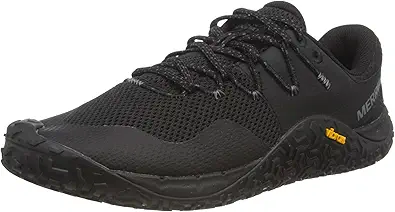
Merrell Trail Glove 7
- Genuine ground feel — none of the deep-stack disconnect
- Vibram TC5+ outsole grips well despite minimal profile
- Wide toe box allows natural foot splay
The Trail Glove is what a barefoot-style trail shoe looks like in 2026. Zero-drop, 6mm stack height, and a Vibram TC5+ outsole that lets you feel rocks, roots, and trail texture in a way every other shoe in this test deliberately blocks. For runners who believe ground feel improves form, builds foot strength, and produces better trail running, this is the only option in the major-brand category.
Be honest with yourself before buying. The Trail Glove requires significant adaptation if you're coming from cushioned shoes. Calves, Achilles, and arch muscles work harder than they do in a Speedgoat. Mileage capacity is far lower — most testers maxed at 6–8 mile runs in the Trail Glove for the first month. Beyond that, foot fatigue accumulated rapidly. Build slowly.
For runners adapted to minimalist footwear, however, the Trail Glove 7 is one of the most enjoyable trail shoes available. Ground feel is genuine, the wide toe box allows natural splay, and the Vibram outsole grips far better than the slim profile suggests. It's also the lightest shoe in the test by a wide margin. If ground feel matters to you, this is the shoe. If it doesn't, choose almost anything else here.
Pros
- +Genuine ground feel — none of the deep-stack disconnect
- +Vibram TC5+ outsole grips well despite minimal profile
- +Wide toe box allows natural foot splay
- +Lightest shoe in the test by a margin
Cons
- −Requires significant adaptation from cushioned shoes
- −Mileage ceiling is lower until adapted
- −Zero-drop is unsuitable for some runners regardless of adaptation
A minimalist specialist for runners committed to ground feel and natural form. Not for everyone — but unmatched for the runners who want it.
Altra Lone Peak 8
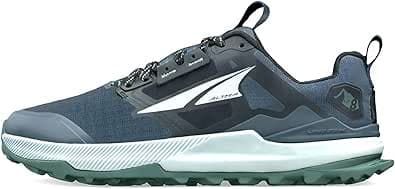
Altra Lone Peak 8
- FootShape last accommodates wide forefoots
- Zero-drop natural position once adapted
- Excellent for thru-hikers and ultra distances
The Lone Peak is the most-loved shoe of the Pacific Crest Trail and Appalachian Trail thru-hiking communities. The reasons match what makes it great for trail running: FootShape last with anatomical toe-splay room, zero-drop natural foot position, and a cushion-to-weight ratio that's ideal for high-mileage long efforts. We covered the Lone Peak earlier on the wide-feet list (Altra Lone Peak 8), and it earns its trail-specific entry here for runners who want the Altra fit on rough terrain.
MaxTrac outsole with 4mm lugs handles dry trail, packed dirt, and mixed terrain with confidence. On wet rock and mud, it falls short of the Vibram Megagrip on the Hoka Speedgoat 6 and the Contagrip on the Salomon Speedcross 6. Stack height is 25mm — moderate for trail running, lower than max-cushion options. EGO MAX foam is responsive without being firm.
The shoe's appeal is fit. Wide forefoot runners who've been pinched by every other trail shoe consistently find their solution in the Lone Peak. Thru-hikers love it for high-mileage day-after-day comfort. Ultra runners value the natural foot position over hundreds of miles. Just remember: zero-drop requires adaptation from traditional shoes. Build slowly into it.
Pros
- +FootShape last accommodates wide forefoots
- +Zero-drop natural position once adapted
- +Excellent for thru-hikers and ultra distances
- +Lightweight relative to cushion
Cons
- −MaxTrac outsole slips on wet rock
- −Zero-drop requires adaptation
- −Less protective than rock-plated alternatives on technical terrain
The thru-hiker and wide-foot trail runner's favorite. If your foot doesn't fit traditional trail shoes, this is the answer.
La Sportiva Prodigio Pro
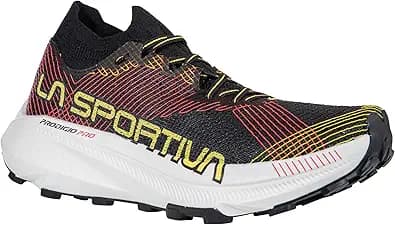
La Sportiva Prodigio Pro
- FriXion Red XF outsole grips technical terrain reliably
- Stiff, precise feel preferred for racing
- Lower stack preserves stability and ground feel
La Sportiva builds Italian-engineered mountain shoes with the precision of climbing equipment. The Prodigio Pro is their fast trail racer — a stiffer, lower-stack, responsive shoe built for technical terrain at competitive speeds. FriXion Red XF rubber outsole with 3.5mm lugs grips wet rock, dry rock, and mixed surfaces with confidence approaching Vibram Megagrip. The lower stack (28mm heel) preserves ground feel and stability over rocks.
This is a race-focused shoe, not a daily trainer. Cushion is deliberately limited. The midsole is firm, the upper is structured for precise lockdown, and the toe box is more snug than most shoes in this test. For technical mountain running where foot placement matters and you need the shoe to stay out of the way, the Prodigio Pro is the strongest performer in the category.
The watch-outs: it's expensive, it's narrow, and it's not appropriate for ultra distances. For 50K and shorter races on technical terrain — alpine routes, rocky singletrack, mountain skyrace — this is the shoe. For a Saturday long run, choose Hoka Speedgoat 6 or Brooks Cascadia 17 instead. La Sportiva builds for a specific use case and excels within it.
Pros
- +FriXion Red XF outsole grips technical terrain reliably
- +Stiff, precise feel preferred for racing
- +Lower stack preserves stability and ground feel
- +Italian build quality and durability
Cons
- −Premium price point
- −Narrow last — not for wide feet
- −Limited cushion makes it inappropriate for ultras
A specialist racing shoe for technical terrain. Brilliant for 50K and shorter mountain efforts; wrong tool for casual or long-distance trail running.
Questions Worth Asking
Common trail running shoes questions.
Related Guides