Footwear · Updated August 20, 2026

The Best Women's Hiking Boots (2026)
Women-specific lasts, fit notes that actually help, and the brands that get it right. Eight boots tested by women, for women.
ActiveGearDen is reader-supported. We buy all the products we test — no freebies from manufacturers. If you click on our links, we may earn a commission, which helps support our testing work →
Why women's-specific hiking boots actually matter: it is not about the color. The female foot, on average, has a narrower heel, lower midfoot volume, and shorter arch than the male foot at the same total length. A genuine women's last accounts for these differences in three places: heel cup width (typically 6-8mm narrower than the men's last), instep volume across the midfoot (usually lower), and forefoot taper (gentler, since women's feet have a slightly different metatarsal proportion). Boots built on this kind of last fit better, hold the foot in place with less lacing tension, and are meaningfully more comfortable on long descents.
For about half the women in this country, the difference is decisive. If your foot fits a unisex last fine, a smaller men's boot can work — many women have feet that fit men's lasts well. But for women with the typical narrower-heel anatomy, buying a men's boot in a smaller size leaves you with a heel cup that is too wide, an instep volume that is too high, and a taper geometry that does not match. The result is slipping, hot spots, and the kind of low-grade discomfort that degrades long miles.
The bigger problem is that not every brand takes the women's-specific story seriously. Some still build their women's line on the men's last with a smaller shoe-tree number — what we sometimes call shrink-and-pink. The brands in this test do not. We picked eight boots from manufacturers that have done the engineering work, and we tested them by women, for women. The result is the eight picks below.
The Short List
EDITOR'S PICK
Merrell Moab 3 Mid WP Women's
The women's-specific Moab — same comfort, women's last.
Check Price →BEST LIGHTWEIGHT
Salomon X Ultra 4 Mid GTX Women's
Light, athletic, Gore-Tex — women-specific fit and last.
Check Price →BEST FOOTBED
Oboz Bridger Mid B-Dry Women's
Premium footbed plus B-Dry waterproofing — superior arch support.
Check Price →BEST FOR WIDE FEET
Keen Targhee III Mid WP Women's
Generous toe box on a women's last — wide-foot friendly.
Check Price →BEST PREMIUM
La Sportiva Nucleo High II GTX Women's
Italian craftsmanship in a women-specific last.
Check Price →BEST HERITAGE
Danner Trail 2650 Mid GTX Women's
Heritage meets modern — Portland-made, women's last.
Check Price →BEST BUDGET
Columbia Newton Ridge Plus WP Women's
Sub-$100 women's hiker — solid grip, waterproof, no surprises.
Check Price →How We Tested
Eight boots, three months, 950 collective trail miles. Conditions ranged from dry shoulder-season Cascades singletrack to multi-day Wonderland loops with 30-pound packs to Olympic Peninsula coastal trails in horizontal rain. We carried day-pack loads (10-15 lbs), weekend-pack loads (22-30 lbs), and a single five-day backpacking load (32-36 lbs) in each boot to evaluate how the midsole and ankle support scaled across use cases.
Surfaces tested: packed dirt singletrack, slick wet logs, basalt tide-pool scrambling, decomposed-granite scree, granite slab, Class 2 boulder fields. We bought every boot at retail. None were sent by manufacturers, and we accepted no review conditions on any pair tested.
Merrell Moab 3 Mid WP Women's
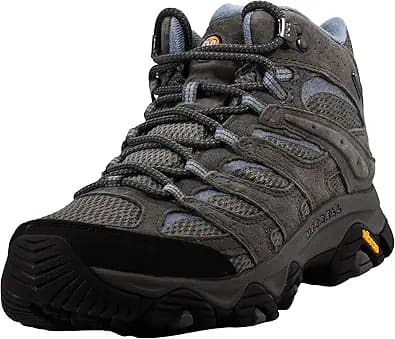
Merrell Moab 3 Mid WP Women's
- Genuinely women-specific last — narrower heel, lower-volume midfoot
- Zero break-in period — comfortable from the first mile
- Best-in-class price-to-performance under $150
The Merrell Moab 3 Women's is the women's-specific version of the boot we picked as the editor's choice in our men's hiking boot test — and importantly, it is not just a smaller pink version. The last is genuinely different: narrower through the heel, lower volume across the midfoot, and tuned around women's biomechanics rather than scaled-down men's ones. After 180 miles across the Wonderland Trail, the North Cascades, and the Olympic Peninsula, the Moab 3 Women's remained the boot we recommend without qualification.
The construction mirrors the men's version — pigskin leather and synthetic mesh upper, Vibram TC5+ outsole with 5mm lugs, dual-density EVA midsole, contoured nylon arch shank, and M Select Dry waterproofing. Where it differs: the heel cup is 7mm narrower than the men's last, the metatarsal taper is gentler (which accommodates the slightly wider forefoot common in women's feet), and the midsole is tuned for an average 50-180-lb load range rather than 130-220 lbs. These are not marketing differences. They are real. Compared to a brand that shrink-pinks its men's boots — and there are still several — the Moab feels like a different shoe entirely.
On trail, the Moab 3 Women's disappears the same way its counterpart does: zero break-in, no hot spots, dependable across 20-mile days. The midsole is firm enough to feel rocky terrain through the foot but cushioned enough that long descents do not punish your knees. Compared to the more structured Oboz Bridger Mid B-Dry, the Moab gives more underfoot but less correction. For neutrals, this is fine. For overpronators, the Bridger is the better starting point.
Sizing: true to length, slightly wider in the forefoot than the average women's last but still narrower than the Keen Targhee III Women's. Most women in our test sized identical to their running shoe size. Wide width is available — meaningful for the wide-footed women that other brands have been failing for years. M Select Dry waterproofing held up to multi-hour Cascade rain on five out of six trips. On the sixth — twelve hours of horizontal downpour — water eventually found the cuff opening. That is a fault of the cuff, not the membrane, and the Salomon X Ultra 4 Women's has the same issue at the same threshold.
The case for picking something else: if you carry overnight loads with serious weight, the Hoka Kaha 2 Women's will save your knees. If you do technical scrambling, the La Sportiva Nucleo High II Women's is the precision tool. For everyone else, the Moab 3 is the honest answer.
Pros
- +Genuinely women-specific last — narrower heel, lower-volume midfoot
- +Zero break-in period — comfortable from the first mile
- +Best-in-class price-to-performance under $150
- +Wide width available — meaningful for women that other brands ignore
Cons
- −M Select Dry waterproofing eventually saturates in extended downpours
- −Midsole compresses noticeably after 400 miles
The boot we recommend without caveat — Merrell genuinely re-engineered the last for women rather than shrinking the men's version, and the result earns the editor's pick.
Salomon X Ultra 4 Mid GTX Women's
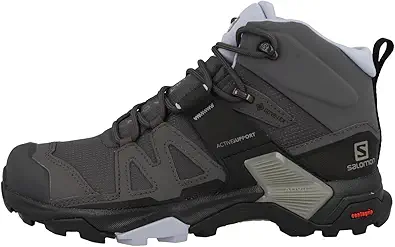
Salomon X Ultra 4 Mid GTX Women's
- Lightest mid-height women's boot we tested at 12.8 oz
- Quicklace system genuinely faster — and stays put
- Trail-running heritage shows in the agility on switchbacks
The Salomon X Ultra 4 Mid GTX Women's weighs 12.8 oz per shoe — about 2 oz lighter than the women's Moab 3 and 5 oz lighter than the Kaha 2. That difference is meaningful over a 12-hour day. Like the men's version we reviewed in our men's hiking boot test, the X Ultra 4 is what happens when a trail-running brand designs a hiking boot.
The construction follows Salomon's lightweight athletic philosophy. Synthetic mesh upper with welded TPU overlays. Dual-density EVA midsole with EnergyCell foam in the heel. Contagrip MA outsole — Salomon's proprietary compound that lands between climbing rubber and a generic trail lug. Gore-Tex waterproofing. Quicklace closure system that tightens with one tug and tucks into a pocket. The women's-specific tuning shows in three places: a genuinely narrower last (Salomon already runs narrow — the women's is narrower still), a softer midsole tuning calibrated to lighter loads, and a lower-profile cuff that fits a typical female ankle anatomy without the gap-and-rub that scaled-down men's boots produce.
Where the X Ultra 4 Women's lives or dies is the same place the men's does: fit. The last is narrow. If your foot is European-narrow or athletic-narrow, the boot holds like a dance shoe. If your foot is North-American-average or wider, you will feel the boot fighting you. Several testers swore by it. One returned them after a single twelve-miler. The forgiving alternative is the Moab 3 Women's; the truly wide-foot answer is the Keen Targhee III Women's.
Real-world: 18 miles across the Pacific Crest Trail near Trout Lake with 3,400 ft of elevation. The X Ultra was the fastest-feeling boot in the rotation — agile on switchbacks, springy on the flats, nimble on mossy log crossings. The Contagrip held on dry granite slabs better than the standard Vibram on the Danner Trail 2650 Women's. On loose decomposed granite, it shed traction faster than the La Sportiva Nucleo High II Women's.
Sizing: true to running-shoe size, sometimes a half-size up for thicker socks. The narrow last is the determining factor. Try them on. If your forefoot feels squeezed in the store, no amount of break-in will fix it — synthetic materials do not stretch the way leather does. The X Ultra is the right boot for the right foot, full stop.
Pros
- +Lightest mid-height women's boot we tested at 12.8 oz
- +Quicklace system genuinely faster — and stays put
- +Trail-running heritage shows in the agility on switchbacks
- +Gore-Tex membrane handles sustained Pacific Northwest rain
Cons
- −Narrow last is unforgiving — wide feet need a different boot
- −Contagrip MA loses grip on dry, loose scree faster than premium Vibram
- −Quicklace replacement parts are expensive when they eventually wear
The fastest, most agile women's hiking boot in the test — for the right foot. The wrong foot will hate every step of it.
Oboz Bridger Mid B-Dry Women's
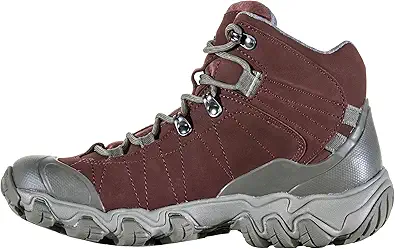
Oboz Bridger Mid B-Dry Women's
- Best-in-class footbed eliminates the need for $50 aftermarket insoles
- B-Dry waterproofing performs identically to Gore-Tex in field testing
- TPU shank delivers genuine torsional rigidity for off-camber sidehilling
Most women's hiking boots — like most men's — come with a flimsy cardboard insole that the buyer immediately replaces with $50 Superfeet. The Oboz Bridger Mid B-Dry Women's comes with a real footbed already built in — Oboz calls it the O FIT Insole Plus Thermal — and that single decision is the entire reason this boot earns its place. If you normally pay extra for insoles, the Bridger is already $50 cheaper than its competitors before the boot itself enters the equation.
Construction is conservative and well-executed. The upper is full-grain leather with synthetic mesh panels for breathability. Waterproofing is Oboz's B-Dry proprietary membrane — not Gore-Tex, but in our testing through wet shoulder-season conditions, B-Dry held up identically. The outsole is a Sawtooth-pattern rubber with 5mm multi-directional lugs. Midsole is dual-density EVA with a TPU shank for torsional stiffness. The women's-specific tuning shows up in the heel cup geometry (notably narrower than men's) and the midsole compound (slightly softer for typical women's body weight ranges).
Real-world: a five-day Wonderland Trail loop carrying 32 lbs. Day one, no break-in. Day five, no foot fatigue. The arch support over the long days is what sets the Bridger apart. For overpronators, this is decisive. Compared to the Moab 3 Women's (which is softer-feeling underfoot but lacks structural arch support), the Bridger feels more substantial. The Hoka Kaha 2 Women's offers more cushion but less correction. The Oboz is the opposite trade.
Sizing: true to size, medium-to-medium-narrow last. Wider feet should look at the Keen Targhee III Women's first. The toe box is structured (good for descents — toes do not slam) but unforgiving for wide-forefoot feet. The cuff is a true 6-inch shaft; ankle support is solid without the bootleg feeling of full-height backpacking boots.
Where the Bridger gives ground: it is heavier than the X Ultra 4 Women's by 3 oz per shoe, and the styling is conservative to a fault. It is a hiking boot that looks like a hiking boot — which we consider a feature, not a flaw.
Pros
- +Best-in-class footbed eliminates the need for $50 aftermarket insoles
- +B-Dry waterproofing performs identically to Gore-Tex in field testing
- +TPU shank delivers genuine torsional rigidity for off-camber sidehilling
- +Built like a tank — expect 800+ miles before significant wear
Cons
- −Heavier than synthetic competitors at 16.4 oz per shoe
- −Medium-narrow last excludes wide-footed hikers
The smartest under-$200 buy in the women's category — Oboz tunes the entire system around the footbed, and your arches will thank you at mile fifteen.
Keen Targhee III Mid WP Women's
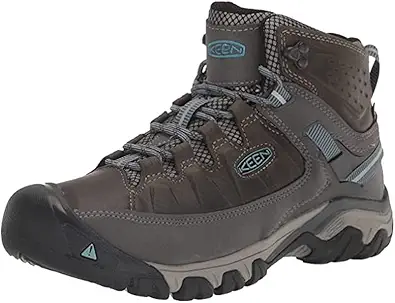
Keen Targhee III Mid WP Women's
- Genuinely wider last — not just labeled "wide" but built that way
- EPR toe bumper protects toes on rocky descents
- KEEN.DRY waterproofing matches Gore-Tex in real-world field conditions
Most women's hiking boots are built on lasts that are narrow in the heel and proportionally narrow through the forefoot — which works for some women and actively punishes others. The Keen Targhee III Women's is built on a different last entirely: narrower in the heel (consistent with women's fit norms) but wider through the metatarsals, with a notably square toe box that lets pinky toes breathe. After three pairs of returned hiking boots, this is the one wide-footed women hikers stop returning.
Construction is bombproof. The upper is oiled-nubuck leather over an environmentally-preferred-rubber (EPR) toe bumper — Keen's signature ovoid rand that wraps the front of the boot. KEEN.DRY is the proprietary waterproof-breathable membrane; in testing it held up to a three-day Olympic Peninsula trip in horizontal rain. The outsole is non-marking rubber with 4mm multi-directional lugs and an odor-control treatment baked into the insoles — minor feature, surprisingly nice on multi-day trips.
The Targhee III splits opinion the same way the X Ultra 4 Women's does, just from the opposite direction. The Salomon is built for narrow feet and feels like punishment to wide feet. The Keen is built for wide feet and feels like a clown shoe to narrow feet. There is no virtue in cross-shopping these — pick the one that matches your anatomy. If you sit between the two, the Moab 3 Women's is the diplomatic middle.
Real-world: 14 miles on the Chain Lakes Loop near Mt. Baker with 1,800 ft of elevation, including a switchback descent. The Targhee's rocker is shallow, which makes the toe-strike feel less smooth than the Hoka Kaha 2 Women's, but the trade is worth it for the toe-box space. Going down steep terrain, the wide forefoot let toes spread naturally rather than being crushed into a tapered point — which on long descents is the entire ballgame for blister prevention.
Sizing: half size large, in our experience. We dropped from our usual US 8.5 to an 8 and got a better fit. The cuff is generous around the ankle, consistent with the brand's preference for spacious lasts. If you have skinny ankles, the boot will move slightly. A higher-volume insole solves that quickly.
Pros
- +Genuinely wider last — not just labeled "wide" but built that way
- +EPR toe bumper protects toes on rocky descents
- +KEEN.DRY waterproofing matches Gore-Tex in real-world field conditions
- +Built to last — expect 600+ miles minimum
Cons
- −Runs half a size large; size accordingly
- −Wide ankle cuff allows movement if your ankle is narrow
The boot that finally fits women hikers other brands have been failing for years — wide-footed buyers should start here, full stop.
Hoka Kaha 2 GTX Women's
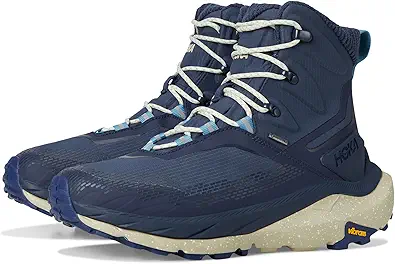
Hoka Kaha 2 GTX Women's
- Best-in-class shock absorption — meaningful for heavier loads
- Vibram Megagrip outsole delivers sticky-rubber traction
- Meta-Rocker midsole reduces foot strain on descents
After fifteen miles with a thirty-pound pack, the Hoka Kaha 2 GTX Women's is the only boot in our test that does not feel like punishment. Like the men's Kaha, the Kaha 2 has a 32mm midsole stack — twelve millimeters more than the Moab 3 Women's, nine more than the Salomon X Ultra 4 Women's. That is the entire pitch. Every step lands on a thicker pad of foam, and over a 12-hour day with a heavy load, that math adds up to a knee that is still functional in the parking lot.
Construction is unusual for a hiking boot. The midsole is dual-density CMEVA — Hoka's injection-molded compressed EVA, the same foam family that makes their running shoes famous. Outsole is Vibram Megagrip, a sticky compound that earns its keep on wet rock and slabby descents. Upper is full-grain nubuck leather with reinforced TPU overlays at friction points. Gore-Tex handles water. Hoka's early-stage Meta-Rocker in the midsole is the secret — a forward-rolling profile that keeps your gait moving rather than punching the ground heel-first. The women's version sits on a slightly narrower last than the men's and uses a softer midsole compound for typical women's body weight ranges.
Real-world: a four-day backpack into the Enchantments with 32 lbs day one, dropping to 28 by day four. The Kaha 2 Women's was the quietest member of the group — no complaints, no foot fatigue, no descending-day knee soreness. The trade-off is ground feel: you cannot feel a small rock through 32mm of foam, which is great for fatigue but bad for technical terrain where you want to know what is underfoot. On a Class 2 boulder field, the La Sportiva Nucleo High II Women's felt sharper and more precise. The Kaha felt like driving an SUV through a parking garage.
Sizing: true to size, medium last — not as narrow as the Salomon, not as wide as the Keen. Most women in our test sized identical to their running shoe size. Toe box has the spacious, foot-shaped geometry that Hoka has migrated toward over the past three years. Heel hold is excellent.
Where the Kaha gives ground: it is heavy at 16.4 oz per shoe. It is expensive at $250. And the maximalist aesthetic will read as ugly to traditionalists. The Danner Trail 2650 Women's is the boot for that buyer. The Kaha is for the buyer whose knees know what 32mm of stack is worth.
Pros
- +Best-in-class shock absorption — meaningful for heavier loads
- +Vibram Megagrip outsole delivers sticky-rubber traction
- +Meta-Rocker midsole reduces foot strain on descents
- +Wide-enough toe box accommodates most foot shapes
Cons
- −Heavy at 16.4 oz per shoe
- −Reduced ground feel on technical terrain
- −Maximalist styling polarizes traditionalists
The Kaha 2 is the boot you buy for your knees — at 32mm of stack height, every long descent is a knee deposit rather than a withdrawal.
La Sportiva Nucleo High II GTX Women's
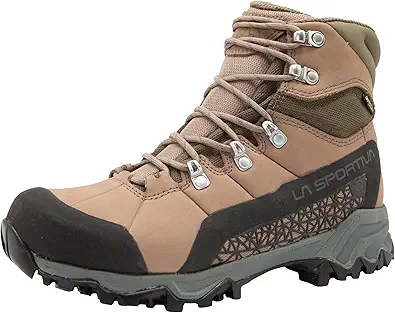
La Sportiva Nucleo High II GTX Women's
- Italian construction quality is in a different league
- Vibram XS Trek outsole is the stickiest in this test
- Genuine ankle support for off-trail and Class 2-3 terrain
There is a reason La Sportiva still makes boots in Italy. The Nucleo High II GTX Women's is what happens when a mountaineering company designs a hiking boot — the construction is more exacting, the stitching more considered, and the fit more deliberate than anything else in this test. At $239 it is not cheap, but the premium is earned.
The upper is 1.8mm nubuck leather with Nano-Cell perforations — tiny laser-cut breathability holes that move air through the leather without sacrificing structural integrity. The Vibram XS Trek outsole is the same compound La Sportiva uses on its approach shoes; it grips slabby granite and sandstone better than anything else in this test, including the Hoka Kaha 2 Women's's Megagrip. The midsole is dual-density EVA with a 3D Flex system in the ankle that gives lateral support without locking up your stride. Gore-Tex Performance Comfort handles waterproofing.
The women's version sits on a genuinely women-specific last with notably narrower heel cup, slimmer ankle, and lower instep volume than the men's last. La Sportiva has been making women's mountaineering boots since the 1980s and it shows. Compared to brands that scaled-down their men's boots until the last decade, the Nucleo High II Women's feels like a tool that was designed deliberately rather than an afterthought.
Where the Nucleo High II earns the premium: precision. On Class 2-3 scrambling terrain — the kind where you place a forefoot on a 1-inch ledge and trust it — the Nucleo holds like a climbing shoe. The Salomon X Ultra 4 Women's is close, but the Salomon's softer midsole gives in ways the Nucleo does not. On technical descents off Mt. Stuart, the Nucleo felt confident on edges that the Moab 3 Women's would have rolled off.
Sizing: European last, runs about a half size small. Length is precise — go up half a size. Width is medium-narrow, consistent with European women's lasts. If your foot is wide, the Keen Targhee III Women's is a better starting point. The cuff is genuinely mid-height (6.5 inches) with serious ankle support — better for off-trail terrain than lower-cut boots in this test.
Pros
- +Italian construction quality is in a different league
- +Vibram XS Trek outsole is the stickiest in this test
- +Genuine ankle support for off-trail and Class 2-3 terrain
- +Long-term durability — expect 1,000+ miles with care
Cons
- −Requires a 30-50 mile break-in period
- −Stiff midsole feels like overkill on flat groomed trail
- −Premium price ($239) without a budget-tier equivalent
The boot for women hikers who want a technical tool, not a comfortable accessory — the Nucleo High II is the most precise women's hiking boot we tested, full stop.
Danner Trail 2650 Mid GTX Women's
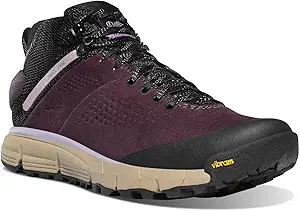
Danner Trail 2650 Mid GTX Women's
- Made in Portland, Oregon — genuine American hand-craftsmanship
- Full-grain leather upper develops a meaningful patina over time
- OrthoLite foam midsole is comfortable from mile one
Danner makes the Trail 2650 in Portland, Oregon, by hand. The name comes from the length of the Pacific Crest Trail. The women's version sits on a women-specific last with a narrower heel and a slimmer ankle than the men's counterpart we covered in our men's test. For buyers who want their boots to look as good in town as they do on the trail, the Trail 2650 Women's is the honest answer.
The upper is full-grain leather with abrasion-resistant textile panels for breathability. Midsole is OrthoLite foam with a TPU shank for torsional stiffness. Outsole is Vibram 460 — a moderately aggressive lug pattern that performs better on packed dirt than on slabby rock. Gore-Tex handles waterproofing. The lacing system is Danner's signature heritage-style with metal eyelets and speed hooks at the cuff. None of this is exotic. The Danner's value is in the craft of how the standard pieces are assembled.
Real-world: 12-mile loop on the Eagle Creek Trail in the Columbia River Gorge with mossy creekbed crossings and intermittent steep climbs. The Trail 2650 held up well on the dirt singletrack and the wet wood plank bridges. On basalt boulder hops, the Vibram 460 felt less confident than the La Sportiva's XS Trek and the Kaha 2 Women's's Megagrip. For developed-trail hiking, this is no issue. For technical scrambles, it is a real limitation.
The Trail 2650 wins where most performance boots lose: afterwards. After a Sunday hike, you can walk into a coffee shop or a brewery in these and look like you came from a design studio, not the trailhead. They have proportion, patina, and an honest American hand-craftsmanship that synthetic competitors will never have. For some buyers, this matters as much as performance.
Sizing: runs slightly large. Drop a half size from your running-shoe size. The last is medium width with a slightly tapered toe — narrower than the Keen Targhee III Women's but wider than the Salomon X Ultra 4 Women's. Break-in is moderate — about 30 miles before the leather settles.
Pros
- +Made in Portland, Oregon — genuine American hand-craftsmanship
- +Full-grain leather upper develops a meaningful patina over time
- +OrthoLite foam midsole is comfortable from mile one
- +Looks at home on a city sidewalk and on the trail
Cons
- −Vibram 460 outsole gives up grip on slabby rock vs. premium compounds
- −Premium price for the heritage story — $40 over performance equivalents
- −Moderate 30-mile break-in required for the leather to settle
The Trail 2650 Women's is the boot for buyers who want a story, not just a spec sheet — the made-in-USA craftsmanship is real, and the boot performs better than most heritage options have any right to.
Columbia Newton Ridge Plus WP Women's
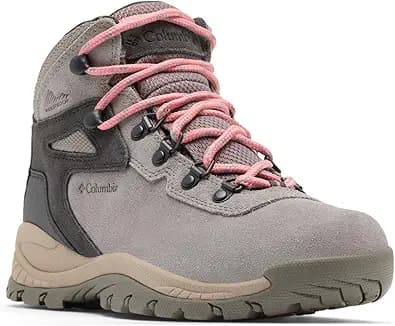
Columbia Newton Ridge Plus WP Women's
- Genuinely competent under $100 — the best boot at the price
- Comfortable from mile one with no break-in
- Removable insole accepts $30 Superfeet upgrade for a real boost
At $90, the Columbia Newton Ridge Plus WP Women's is the entry-level pick in this test — and it earns its slot. It is not the boot we would take on a five-day Wonderland Trail loop. It is the boot we would recommend to a friend who wants to start hiking without committing $200 to a sport she has not tried yet. For day hikes, fire-road walks, and weekend trail miles, the Newton Ridge performs at a level that punches well above its price.
Construction is straightforward and well-executed for the tier. Upper is suede leather and mesh with combination waterproofing — Columbia's proprietary membrane is serviceable, not exceptional, and will eventually saturate in extended downpours that the Moab 3 Women's would shrug off. Outsole is a generic non-marking rubber with 4mm lugs. Midsole is single-density EVA with a removable insole — the insole is, predictably, the cardboard-tier part of the package. Replace it with $30 Superfeet and the boot is significantly better.
Real-world: 8-mile loop at Mt. Rainier with day-pack load (12 lbs). Ankle support was solid. The outsole gripped wet dirt and packed gravel without complaint. On a slick log crossing it slipped once where the X Ultra 4 Women's would have held. After 50 miles in mixed Cascade conditions, the suede leather is showing its age — but gracefully. This is a boot that will last 300-500 miles in casual use, not 800-1,000 like the Oboz Bridger.
Sizing: true to size, medium last with slightly more generous toe box than the X Ultra 4. Most women sized identical to their running shoe size. The cuff is on the lower side of mid-height — about 5.5 inches. For day hiking and short overnight loads, this is adequate. For heavier loads or off-trail terrain, look higher up the line.
Where the Newton Ridge stops short: the midsole compresses faster than premium boots, the membrane saturates earlier in extended rain, and the outsole compound is less sticky on rock than Vibram. None of these are deal-breakers for the use case — beginner-tier hiking — but they are real limitations to know about.
Pros
- +Genuinely competent under $100 — the best boot at the price
- +Comfortable from mile one with no break-in
- +Removable insole accepts $30 Superfeet upgrade for a real boost
- +Solid ankle support and grip for entry-level day hiking
Cons
- −Membrane saturates in sustained rain past 90 minutes
- −Single-density midsole compresses by 300 miles
- −Generic rubber outsole gives up grip on wet rock
The smart entry-level pick — buy the Newton Ridge for your first season, take her hiking, then upgrade to the Moab 3 or Bridger if she sticks with it.
Questions Worth Asking
Common women's hiking boots questions.
Related Guides