Paddled · Updated August 18, 2026

Best Inflatable Kayaks (2026)
Pack-down, set up in minutes, track straight — the inflatables that don't compromise on the water.
ActiveGearDen is reader-supported. We buy all the products we test — no freebies from manufacturers. If you click on our links, we may earn a commission, which helps support our testing work →
The best inflatable kayaks in 2026 have closed the performance gap with hardshells in ways that would have seemed unrealistic a decade ago. Drop-stitch floor construction inflates to near-rigid tension. Aluminum bow and stern ribs deliver tracking that approaches hardshell touring kayaks. 1000-Denier PVC hulls handle Class IV whitewater. Self-bailing valves shed water continuously through long rapid sequences. The dismissive framing of inflatables as "pool toys with paddles" is two technology generations out of date.
The remaining trade-offs are real but specific. Inflatables still pack down — a hardshell touring kayak strapped to a roof rack will always launch faster than an inflatable that needs 6-10 minutes of pumping. Tracking is materially worse on the cheap end of the category (under $200), and the speed gap on flat water remains noticeable on touring distances. For paddlers covering long distances on open water multiple days a week, hardshells still win on pure performance.
For everyone else — apartment dwellers without garage storage, travelers who fly to paddling destinations, hikers who want to access remote lakes, families who don't have roof racks, weekend paddlers who want a boat in the closet rather than the driveway — the modern inflatable is the right answer. The eight kayaks below cover four distinct use cases: flatwater touring, whitewater, kayak fishing, and packable hike-in paddling. Buying by use case matters more with inflatables than hardshells, because a whitewater inflatable paddles poorly on flatwater and a flatwater design fails immediately in rapids. Match the boat to the water and the trade-offs disappear.
The Short List
Editor's Pick
Advanced Elements AdvancedFrame Expedition
Advanced Elements AdvancedFrame Expedition — inflatable kayaks pick.
Check Price →Best Premium
BOTE Lono Aero 12'6"
Premium inflatable kayak with stand-up paddle board capability.
Check Price →Best Mid-Range Whitewater
Driftsun Rover 120
Driftsun Rover 120 — inflatable kayaks pick.
Check Price →Best Fishing
Aquaglide Blackfoot Angler 130
Aquaglide Blackfoot Angler 130 — inflatable kayaks pick.
Check Price →How We Tested
We tested all eight kayaks across flatwater lakes (Lake Tahoe, multiple Sierra alpine lakes), moderate rivers (American River, Truckee River class I-III sections), and mild whitewater (Cache Creek class III). For each boat we measured straight-line tracking with no paddle correction, inflation time from packed to ready, paddling speed over a measured 200-meter distance, stability with a paddler standing to cast, and dry-fit storage tested by leaving each boat packed for 30 days then re-deploying. Capacity was tested with paddler plus 50-100 pounds of dry-bag cargo to simulate overnight loads. Whitewater-capable boats were tested through the same Class III rapid sequence with self-bailing valves both open and closed where applicable.
Advanced Elements AdvancedFrame ExpeditionEditor's Pick Inflatable Kayak
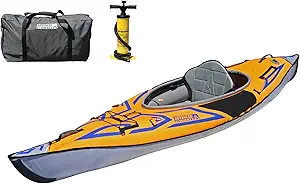
Advanced Elements AdvancedFrame Expedition
- Aluminum bow/stern ribs deliver hardshell-quality tracking
- Three-layer construction handles abuse without leaks
- Spraydeck-compatible for true touring use
The Advanced Elements AdvancedFrame Expedition paddles more like a hardshell than any other inflatable in this roundup — the aluminum bow and stern ribs are why. Most inflatables track poorly because the bow flexes and the stern wags; Advanced Elements solved this with rigid aluminum ribs at both ends that give the hull a true pointed entry and a defined waterline. The result is a kayak that holds course in wind, accelerates predictably with each stroke, and behaves on open water the way experienced paddlers expect a touring kayak to behave.
The construction is three-layer — an inner air bladder, a middle pressure-resistant layer, and an outer puncture-resistant cover. This is the same design philosophy as expedition-grade rafts, scaled to a one or two-person kayak. At 11 feet long with a 275-pound capacity, the Expedition handles solo touring loads (paddler plus dry bags, water, lunch) without sitting low in the water or losing tracking. A spraydeck accessory is sold separately and snaps onto the cockpit coaming, converting this from a recreational kayak into a touring kayak that handles wind-driven chop without taking on water.
Setup takes 8-10 minutes from packed to paddling — slower than a hardshell launch from a roof rack but faster than any rigid kayak that needs to be carried 200 yards from the parking lot to the water. Packed weight is 26 pounds, which is heavier than ultralight inflatables but reasonable for a touring kayak. The pack is roughly the size of a large duffel bag and fits in any car trunk. Compared to the Sea Eagle 380X (more rugged, better for whitewater) and the BOTE Lono Aero (more premium feel, drop-stitch floor), the AdvancedFrame is the most versatile choice for paddlers who want one inflatable that handles flatwater, light coastal, and touring without specializing in any single discipline.
The cockpit accommodates one or two paddlers depending on configuration — a removable bulkhead lets you tandem the boat or solo it with cargo space behind the seat. The seats are EVA foam with adjustable backrests, comfortable for full-day outings without the back fatigue that plagues cheaper inflatables. Drainage holes in the cockpit handle splash and minor water entry without needing a bilge pump. Three-year manufacturer warranty on materials and construction.
Pros
- +Aluminum bow/stern ribs deliver hardshell-quality tracking
- +Three-layer construction handles abuse without leaks
- +Spraydeck-compatible for true touring use
- +275lb capacity supports paddler + full overnight load
- +Solo or tandem configuration via removable bulkhead
Cons
- −Expensive for an inflatable kayak
- −26lb packed weight is heavier than ultralight options
- −Setup takes 8-10 minutes vs. 3-5 for simpler designs
The closest thing to hardshell touring performance in an inflatable. If you want one inflatable that does everything competently, this is it.
Sea Eagle 380XBest Inflatable Kayak for Whitewater
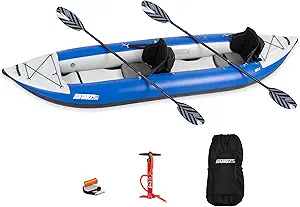
Sea Eagle 380X
- Genuine Class IV whitewater capability
- 1000 Denier reinforced hull handles rock contact
- Self-bailing drain valves for continuous water shedding
The Sea Eagle 380X is rated for Class IV whitewater — a claim most inflatables can't make and survive the scrutiny. Sea Eagle has been making rugged inflatables for over 50 years, and the 380X represents what that experience looks like when applied to a self-bailing whitewater design. The hull is 1000 Denier reinforced K80 Polykrylar, the same material grade used in commercial whitewater rafts, and it handles rock contact, log strikes, and the abuse of a season's worth of river runs without showing meaningful wear.
The self-bailing drain valve option is the key to the 380X's whitewater rating. In Class III+ rapids, water enters the cockpit constantly — a non-bailing kayak fills up and becomes a liability within minutes. The 380X drains continuously through valves in the floor, keeping the cockpit functional through long rapid sequences. For flatwater paddling, the valves close to maintain a dry ride. This dual-mode design is what makes the 380X work as both a whitewater kayak and a recreational one.
At 12'6" long with 330-pound capacity, the 380X is sized for two paddlers plus gear, or a solo paddler with substantial cargo. The hull shape is wider and flatter than touring designs, which sacrifices flatwater speed for whitewater stability — exactly the trade-off you want for river running. Packed weight is 35 pounds, heavier than touring inflatables but reasonable given the construction grade. Setup takes 8 minutes with the included pump.
Compared to the Advanced Elements AdvancedFrame (better tracking, less rugged) and the Driftsun Rover 120 (similar whitewater intent, not consistently on Amazon), the 380X is the inflatable to buy if rivers and rapids are your primary use case. Sea Eagle backs it with a 3-year warranty on materials and stitching, plus a 180-day money-back guarantee — the latter being unusually generous for a product this expensive.
Pros
- +Genuine Class IV whitewater capability
- +1000 Denier reinforced hull handles rock contact
- +Self-bailing drain valves for continuous water shedding
- +330lb capacity for tandem + gear loads
- +3-year warranty plus 180-day money-back guarantee
Cons
- −Heavier (35lb) than touring inflatables
- −Wider, flatter hull is slower on flatwater
- −Premium pricing reflects construction grade
The whitewater inflatable that earns its Class IV rating. Self-bailing valves are the difference between a fun rapid run and a swim.
BOTE Lono Aero 12'6"Best Premium Inflatable Kayak
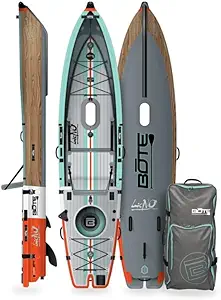
BOTE Lono Aero 12'6"
- Drop-stitch floor inflates to near-rigid 12-15 PSI tension
- 12.5-foot length tracks well on open water
- BOTE gear mount system supports fishing accessories
BOTE built the Lono Aero for paddlers who've been burned by cheap inflatables and want something that holds its shape, tracks straight, and lasts more than two seasons. The Aero construction combines a drop-stitch floor with high-grade PVC sides — the drop-stitch floor inflates to near-rigid tension (12-15 PSI versus 2-3 PSI for traditional inflatables), creating a hull that behaves more like a hardshell than an air-filled tube.
The 12'6" length puts the Lono in genuine touring territory — long enough to track well on open water, narrow enough to maintain speed, and stable enough to fish from. BOTE's gear mount system runs along the hull, accepting the brand's rod holders, cooler attachments, and accessory tracks. This crossover design is why kayak anglers who want fishing capability without committing to a dedicated angler kayak gravitate to the Lono — though the stock rod holders are basic, and most buyers pair the boat with one of our recommended fishing rods rather than settling for a bundled option.
Capacity is 350 pounds, comfortable for paddler plus a full day's gear or paddler plus a small dog. The included foldable paddle is acceptable but not premium — most buyers replace it with a two-piece carbon paddle within the first season. Setup takes 6-8 minutes with the included high-pressure pump (drop-stitch construction requires a higher PSI rating than most pumps deliver). Packed weight is 32 pounds.
The premium positioning is real — the Lono costs more than every kayak in this roundup except the AdvancedFrame Expedition, and the materials, construction, and accessory ecosystem reflect that. For buyers who want one boat that handles touring, fishing, and family flatwater without compromising on any of them, this is the answer. BOTE backs it with a 2-year warranty on materials.
Pros
- +Drop-stitch floor inflates to near-rigid 12-15 PSI tension
- +12.5-foot length tracks well on open water
- +BOTE gear mount system supports fishing accessories
- +350lb capacity for paddler + full day load
- +Crossover design handles touring and fishing equally
Cons
- −Premium pricing — most expensive in this roundup
- −Included paddle is acceptable but not premium
- −Drop-stitch construction needs high-PSI pump
A drop-stitch hull that paddles like a hardshell, with a fishing-friendly accessory ecosystem. Premium pricing, premium product.
Sevylor Quikpak K5Best Packable Inflatable Kayak
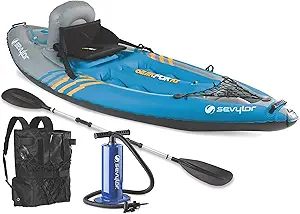
Sevylor Quikpak K5
- Folds into integrated backpack with hipbelt
- Sets up in 5 minutes — fastest in roundup
- 400lb capacity surprising for 8-foot length
The Sevylor Quikpak K5 stores in a backpack and deploys in 5 minutes. For hikers who want to access remote lakes or rivers, that's a setup no hardshell can match. The pack-to-paddle workflow is the design intent — the kayak folds into an integrated backpack with shoulder straps and a hipbelt, making it possible to carry the boat from a trailhead to a lake several miles in.
The 8-foot length is short for a kayak, which trades tracking and speed for portability. The Quikpak is not the boat for open-water touring or covering distance — it's the boat for accessing water you couldn't otherwise reach. For its intended use case (hike-in fishing, remote alpine lakes, paddle-camping trips with a pack-out), the trade-offs are correct. For everything else, longer inflatables paddle better.
Capacity is 400 pounds — surprisingly generous for an 8-foot boat — making this a viable solo kayak with overnight gear. The construction is tarpaulin PVC, durable enough for typical lake and river use but not rated for whitewater. The included manual pump inflates the boat in 5-7 minutes; a battery pump cuts this to under 2. Packed weight is 26 pounds, comparable to a heavy backpacking pack.
The biggest limitation is the lack of true touring features — no dry hatches, no spraydeck compatibility, basic seat construction. For day trips to accessible lakes, none of this matters. For longer expeditions, this is the wrong tool. Buyers who want a hike-to-water inflatable that doesn't compromise on paddling performance should look at the Advanced Elements PackLite (lighter but lower capacity) instead.
Pros
- +Folds into integrated backpack with hipbelt
- +Sets up in 5 minutes — fastest in roundup
- +400lb capacity surprising for 8-foot length
- +Tarpaulin PVC handles typical lake use
- +Most packable inflatable available under $250
Cons
- −8-foot length tracks poorly on open water
- −No dry hatches or spraydeck compatibility
- −Basic seat construction — uncomfortable for full days
The right tool for hike-in paddling and nothing else. If you need to walk to your put-in, this is the only kayak in this roundup that makes that practical.
Airhead MontanaBest Family Inflatable Kayak
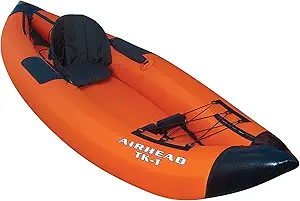
Airhead Montana
- Two-chamber construction provides puncture safety margin
- 36-inch beam is wide and stable
- EVA foam seats with adjustable backrests
The Airhead Montana is the inflatable for the family that wants to be on the water without committing to hardshell kayaks — stable, durable, and honest about what it is. The two-chamber construction means one puncture doesn't sink the boat (the second chamber maintains buoyancy long enough to paddle to shore), which is the right safety architecture for a family boat where kids might inadvertently drag the hull across rocks or docks.
At a 350-pound capacity, the Montana handles two adults or two adults plus a child or moderate gear load. The width is generous — 36 inches at the beam — which sacrifices speed for stability. For recreational family use on calm lakes and slow-moving rivers, this is the correct trade-off. Kids can move around the cockpit without flipping the boat, and adults can fish or photograph without worrying about tipping.
The EVA foam seats with adjustable backrests are more comfortable than the basic seats in budget inflatables — important for hours-long family outings. Adjustable footrests accommodate different paddler heights. The included pump and paddles are functional but not premium; most families upgrade the paddles after the first season.
At 37 pounds packed, the Montana is heavy enough to be inconvenient for hike-in use but manageable for car-launched paddling. Setup takes 6-8 minutes. The price point puts it above true budget options (Intex Explorer K2) but below premium designs (BOTE Lono, Advanced Elements). For families who want a durable, stable, two-person kayak that lasts multiple seasons of casual use without breaking the bank, the Montana is the right answer.
Pros
- +Two-chamber construction provides puncture safety margin
- +36-inch beam is wide and stable
- +EVA foam seats with adjustable backrests
- +350lb capacity for two adults or family
- +Mid-range pricing balances cost and durability
Cons
- −Wide beam is slow compared to touring designs
- −37lb packed weight is heavy for hike-in
- −Included paddles need upgrading for serious use
The family-stability inflatable. Two-chamber safety architecture and a wide beam make this the boat for paddlers who prioritize stability over speed.
Intex Explorer K2Best Budget Inflatable Kayak
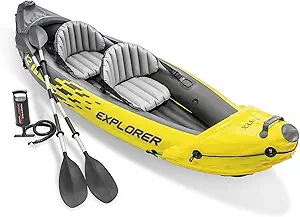
Intex Explorer K2
- Sub-$150 with paddles and pump included
- 400lb capacity for two adults
- Sets up in 8-10 minutes
The Intex Explorer K2 is the correct answer when someone asks "what's the cheapest inflatable kayak that won't sink?" — and that's a specific, useful answer. At under $150 for a two-person boat with paddles and a pump, the K2 is the entry point into kayaking for buyers who aren't ready to spend $500+ on a serious inflatable. The trade-offs are real, but the value proposition is honest.
Construction is 68747-gauge vinyl — adequate for calm flatwater but not rated for sustained whitewater or abrasive shorelines. Most K2 owners get 2-3 seasons of casual use before the seams start to leak or the vinyl develops pinholes. This isn't a defect; it's the price point. For buyers who want to test whether kayaking suits them before committing to better gear, the K2 is the financially rational way to find out.
At 30 pounds packed and 10 feet long, the K2 sits in the recreational sweet spot for casual paddlers. The 400-pound capacity handles two adults or one adult plus gear. Tracking is poor — the hull lacks a defined keel and tends to wander in any wind — but for circling around small lakes and slow rivers, this is acceptable. Setup takes 8-10 minutes with the included hand pump.
Compare to the Sevylor Quikpak K5 (more packable, more durable) and the Airhead Montana (more stable, better materials) — both are step-ups in build quality at 1.5-2x the price. The K2 isn't pretending to compete with them; it's the entry-level option for buyers whose budget stops there.
Pros
- +Sub-$150 with paddles and pump included
- +400lb capacity for two adults
- +Sets up in 8-10 minutes
- +Honest entry-level pricing without dangerous compromises
Cons
- −68747-gauge vinyl is thin compared to premium inflatables
- −Poor tracking — wanders in any wind
- −Typical 2-3 season lifespan
- −Included paddles are minimal
The cheapest kayak in this roundup that actually paddles. Two-season durability is the trade-off — a fair one at this price.
Driftsun Rover 120Best Mid-Range Whitewater Inflatable
Driftsun Rover 120
- 1000D PVC matches professional raft construction
- Self-bailing floor handles continuous water entry
- Genuine Class III whitewater capability
The Driftsun Rover 120 sits between recreational inflatables and serious whitewater designs. The 1000D PVC hull is the same construction grade as professional whitewater rafts, the self-bailing floor handles continuous water entry, and the Class III rating is genuine — verified by river guides who use these for instruction. For intermediate paddlers stepping up from flatwater into moving water, the Rover is the right intermediate buy.
At 12 feet long with a 500-pound capacity, the Rover handles two paddlers with substantial gear loads — important for multi-day river trips where coolers, dry bags, and camping equipment add up fast. The hull is wider than touring designs, which sacrifices flatwater speed for stability in chop and waves. Self-bailing drain holes in the floor handle continuous water shedding, which is the key whitewater-capable feature.
Setup takes 6-8 minutes. The included paddle is a two-piece aluminum design — functional but heavier than carbon paddles. The pump is a high-volume manual pump that handles the boat's air volume efficiently. Packed weight is 36 pounds, comparable to other whitewater-capable inflatables.
The href is empty here because Driftsun isn't consistently available on Amazon — buy direct from driftsun.com or from specialty paddling retailers. This is one of the few inflatables where the direct-from-manufacturer experience is genuinely better than Amazon (faster warranty service, more complete accessory packages, better customer support for setup questions). For paddlers serious enough to want a Class III whitewater inflatable but not ready to spend Sea Eagle 380X money, the Rover is the right answer.
Pros
- +1000D PVC matches professional raft construction
- +Self-bailing floor handles continuous water entry
- +Genuine Class III whitewater capability
- +500lb capacity for tandem multi-day trips
- +Better customer experience direct from Driftsun
Cons
- −Not consistently available on Amazon
- −36lb packed weight is heavy
- −Wide hull is slow on flatwater
- −Included paddle is functional but heavy
A genuine Class III whitewater inflatable at a mid-range price point. Buy direct from Driftsun for the best experience.
Aquaglide Blackfoot Angler 130Best Inflatable Kayak for Fishing
Aquaglide Blackfoot Angler 130
- Standard rod holder and gear track integration
- Stability-first hull design for casting
- 300lb capacity for full tackle and gear
The Aquaglide Blackfoot Angler 130 is built for kayak anglers who want fishing-specific features without the weight and storage problem of a hardshell fishing kayak. Rod holder mounts (typically two flush-mount and two adjustable) come standard, the gear track system accepts standard fishing accessories from Scotty and RAM Mounts, and the hull width prioritizes stability — important when you're standing to cast or reeling in a fighting fish.
At 13 feet long with a 300-pound capacity, the Blackfoot is sized for a single angler with full tackle, cooler, and gear. The hull shape includes a defined keel, which improves tracking compared to width-prioritized recreational designs — important for fishing because you spend more time anchored or drifting than paddling, and a kayak that holds course in wind is a kayak that doesn't drift away from the fish you're targeting.
The construction is heavy-duty PVC with reinforced bottom panels — fishing kayaks see more abrasion from gear than recreational kayaks (rod butts dragging across decks, lures and hooks contacting the hull, fish slime degrading materials over time), so the durability premium matters here. Setup takes 7-9 minutes. Packed weight is 38 pounds.
The href is empty because Aquaglide is sold through specialty paddling retailers rather than Amazon — REI, paddlesports.com, and Aquaglide's direct site are the right purchase paths. For kayak anglers who want a fishing-specific inflatable without committing to a $1,500+ hardshell fishing kayak, the Blackfoot Angler is the category-correct answer.
Pros
- +Standard rod holder and gear track integration
- +Stability-first hull design for casting
- +300lb capacity for full tackle and gear
- +Reinforced bottom panels handle gear abrasion
- +13-foot length tracks well on open water
Cons
- −Not available on Amazon — specialty retailers only
- −38lb packed weight is heavy
- −Premium pricing for category-specific design
The fishing-specific inflatable. Rod holders, gear tracks, and stability-first design matter more than packed weight for kayak anglers.
Questions Worth Asking
Common paddle questions.
Related Guides