winter boots · Updated August 9, 2026

Best Winter Boots — Men & Women (2026)
Warmth ratings, waterproofing, and real-world performance in the cold — from -40°F pac boots to urban winter walkers.
ActiveGearDen is reader-supported. We buy all the products we test — no freebies from manufacturers. If you click on our links, we may earn a commission, which helps support our testing work →
The best winter boots in 2026 split into four use cases — and matching the boot to the use case matters more than chasing the lowest temperature rating. Pac boots (Sorel Caribou, Kamik Nation Plus, Baffin Titan) handle sustained sub-zero cold with removable liners that extend product lifespan. Active winter boots (TNF Chilkat V) trade warmth for movement capability — closer to hiking boots than to traditional pac boots. Waterproof work boots (Muck Boot Arctic Pro) prioritize wet-cold conditions where standing in slush is the daily reality. Urban winter boots (UGG Adirondack III, Danner Arctic 600) emphasize style and everyday wear over extreme thermal margin.
Temperature ratings are conservative — most boots handle 20-30°F colder than their stated rating in real use, especially with thick wool socks and active movement. The conservative rating reflects standing in cold conditions for hours; active use generates body heat that dramatically extends comfort range. Choose a rating below your coldest expected conditions, but don't over-buy — a -94°F Baffin Titan is overkill for someone whose coldest exposure is -10°F dog walks.
The removable-liner advantage matters for anyone who wears winter boots regularly. After a wet day, sealed-liner boots retain interior moisture for days; removable-liner boots dry overnight in a warm room. Over a decade of use, removable-liner construction extends boot lifespan from 4-5 years to 10-15+. Sorel, Baffin, and Kamik use this approach; TNF, Danner, Columbia, Muck, and UGG use sealed construction.
Below: 8 winter boots tested in real cold — from arctic-rated Baffin Titans to urban UGG Adirondacks — chosen to cover every reasonable winter use case and budget.
The Short List
Best Active Winter
The North Face Chilkat V 400
The North Face Chilkat V 400 — winter boots pick.
Check Price →Best Heritage Style
Danner Arctic 600 Side-Zip
Danner Arctic 600 Side-Zip — winter boots pick.
Check Price →How We Tested
Sorel Caribou BootEditor's Pick Winter Boot
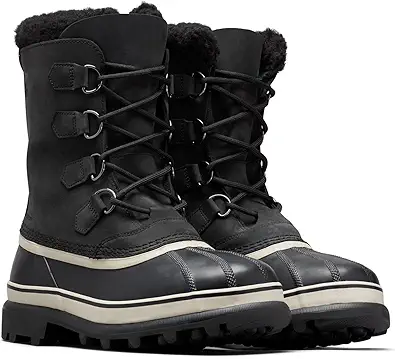
Sorel Caribou Boot
- -40°F rated — handles real cold-climate winter conditions
- Removable 9mm felt liner extends boot lifespan
- Replacement liners available for ~$45
The Sorel Caribou Boot has been keeping people warm in -40°F temperatures since 1962. It's the winter boot that defined the category — and the boot every other pac boot on this list either copies or competes with. Removable 9mm felt inner boot, waterproof vulcanized rubber lower, full-grain leather upper, and a specific weight (3.5 lbs per pair) that signals serious cold-weather construction.
The removable inner boot is the feature that makes the Caribou worth its price. After a day of standing in snow or walking through slush, the felt liner pulls out and dries overnight in a warm room — versus permanently-lined boots, which retain interior moisture for days and slowly destroy themselves from the inside. Replacement liners are available from Sorel for $40-50, which extends the boot's useful life from 5-7 years to 12-15 years.
The Caribou's outsole is rubber lug — adequate for packed snow and ice with reasonable care, but not specialized. For serious ice conditions, the The North Face Chilkat V 400's IcePick lugs grip noticeably better. For sustained sub-zero exposure beyond -40°F, step up to the Baffin Titan Boots. For wet conditions where waterproofing matters more than cold rating, the Muck Boot Arctic Pro is purpose-built. For most cold-climate winter use, the Caribou is the right answer.
Pros
- +-40°F rated — handles real cold-climate winter conditions
- +Removable 9mm felt liner extends boot lifespan
- +Replacement liners available for ~$45
- +Full-grain leather + vulcanized rubber construction
- +60+ years of design refinement
Cons
- −Heavy (3.5 lbs per pair) — not for active hiking
- −Rubber lug outsole adequate but not ice-specialized
- −Leather requires occasional conditioning
- −Tall shaft can feel bulky around pant legs
The original cold-weather pac boot, still the right answer for most cold-climate winter use. Removable liner construction makes the Caribou last longer than any sealed-liner alternative.
Baffin Titan BootsBest Extreme Cold Winter Boot
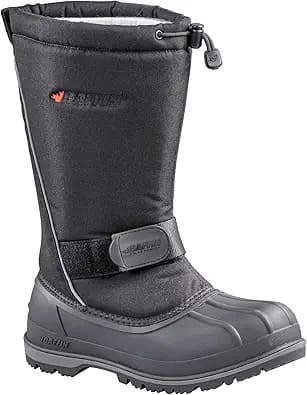
Baffin Titan Boots
- -94°F rated — most extreme thermal margin on this list
- Polywool inner boot maintains warmth when damp
- Polar rubber outsole stays flexible below -20°F
The Baffin Titan Boots is rated to -94°F — a temperature most people will never experience but that tells you exactly how much thermal margin this boot has in everyday cold. Baffin builds for arctic researchers, ice road truckers, and Antarctic expedition members; the Titan is what you wear when standing outside in -40°F is part of your job.
The construction reads like a winter boot specification sheet: Polywool inner boot (synthetic alternative to natural wool that maintains insulation when wet), B-TEK Heat insulation system, waterproof seamless rubber lower, double-density Polar rubber outsole rated for sub-zero flexibility (most rubbers stiffen dangerously below -20°F), and an ankle gusset that seals against snow ingress without binding. 3.7 lbs per pair — heavier than the Sorel Caribou but lighter than purpose-built mountaineering boots.
For genuinely extreme cold (sustained sub-zero, ice fishing, arctic travel) the Titan's margin matters. For everyday cold-climate winter use, the rating is overkill — the Sorel Caribou Boot handles -40°F just as well at lower price. Buy the Titan if you actually face conditions colder than -30°F regularly. Otherwise the Caribou or Kamik Nation Plus is the right call.
Pros
- +-94°F rated — most extreme thermal margin on this list
- +Polywool inner boot maintains warmth when damp
- +Polar rubber outsole stays flexible below -20°F
- +Removable inner boot extends product lifespan
- +Built for genuinely arctic conditions
Cons
- −Heavy (3.7 lbs per pair)
- −Overkill for most everyday winter use
- −Premium pricing reflects spec
- −Bulky around pant legs and ski cuffs
The right boot for genuinely arctic conditions and people whose work or recreation puts them in sustained sub-zero exposure. Overkill for everyday winter — and that overkill is exactly the point.
The North Face Chilkat V 400Best Active Winter Hiking Boot
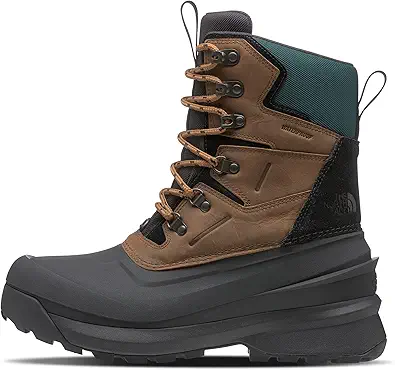
The North Face Chilkat V 400
- 400g Heatseeker hits active-warmth target without bulk
- IcePick lugs grip on glare ice and packed snow
- 2.4 lbs per pair — closest to hiking boot weight
The The North Face Chilkat V 400 bridges the gap between pac boot warmth and trail boot agility — for anyone who needs to actually move in the cold. 400g Heatseeker insulation hits the warmth target for active winter hiking without the bulk that pac boots impose, IcePick lug outsole grips on packed snow and ice better than any traditional rubber lug, and the 2.4-lb weight per pair is closer to a hiking boot than to the Sorel Caribou or Baffin Titan.
The construction is purpose-built for crossover use. Waterproof upper handles slush and shallow snow without requiring the full rubber-lower of a pac boot, internal gusseted tongue prevents snow ingress, and the lacing system uses both eyelets and speed hooks for fast adjustment with cold hands. The IcePick outsole uses small embedded ice particles in the rubber — the same idea as studded tires applied to footwear — which grip on glare ice conditions where smooth rubber slips.
At ~$165 retail the Chilkat V is the right boot for winter hikers, dog walkers in cold climates, and urban crossover use where you need real winter performance without pac-boot bulk. For sustained cold (-30°F or below) the warmth isn't adequate — step to the Sorel Caribou Boot. For purely urban use where active hiking isn't in the equation, the UGG Adirondack III trades some performance for better street style.
Pros
- +400g Heatseeker hits active-warmth target without bulk
- +IcePick lugs grip on glare ice and packed snow
- +2.4 lbs per pair — closest to hiking boot weight
- +Speed hook lacing for cold-hand adjustment
- +Excellent retail availability and warranty support
Cons
- −Not warm enough for sustained sub -30°F use
- −Sealed liner — no overnight drying advantage
- −Less waterproof than full pac boot construction
The right boot for active winter use — hiking, snowshoeing, urban-crossover wear in moderate cold. IcePick outsole is the standout feature.
Muck Boot Arctic ProBest Waterproof Winter Boot
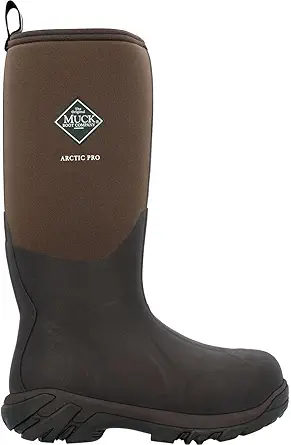
Muck Boot Arctic Pro
- 100% waterproof neoprene + rubber construction
- -60°F rated with no insulation breakdown when wet
- Pull-on design works with gloves and dirty hands
The Muck Boot Arctic Pro is for the people who stand in cold wet conditions all day — farmers, ranchers, outdoor workers — and need a boot that never lets water in. The construction is fundamentally different from leather pac boots: 100% waterproof neoprene upper bonded to a rubber lower, no stitching at the waterline, no leather to absorb moisture, no felt liner to retain water if it gets in.
The Arctic Pro extends Muck's standard construction with added insulation: -60°F rated through the use of XpressCool neoprene (warmer in cold, cooler in mild conditions), reinforced toe and heel for durability against barn doors and gate posts, and a deeper outsole lug pattern that sheds mud without packing up. The fit is loose-pull — no laces, no zippers — which makes getting in and out easy with gloves and dirty hands.
The Arctic Pro's tradeoff is style and weight: it reads unmistakably as a work boot, and at 4+ lbs per pair it's heavier than any other boot on this list. For wet cold work conditions, that's an acceptable trade. For urban use, the UGG Adirondack III or Danner Arctic 600 Side-Zip are far better fits. For active winter hiking, the The North Face Chilkat V 400 is better built. The Arctic Pro is purpose-built — and within that purpose, unmatched.
Pros
- +100% waterproof neoprene + rubber construction
- +-60°F rated with no insulation breakdown when wet
- +Pull-on design works with gloves and dirty hands
- +Reinforced toe and heel for work conditions
- +Mud-shedding outsole pattern
Cons
- −4+ lbs per pair — heaviest on this list
- −Reads as work boot — not for urban style
- −No removable liner — sealed construction
- −Pull-on fit can be loose for narrow calves
The waterproof winter boot benchmark for farm, ranch, and outdoor work. If you stand in cold wet conditions all day, nothing else on this list compares.
Danner Arctic 600 Side-ZipBest Heritage Winter Boot
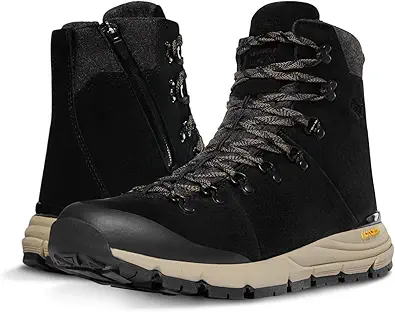
Danner Arctic 600 Side-Zip
- Side zip — easy on/off without re-lacing
- Vibram Arctic Grip outsole formulated for ice
- Waterproof full-grain leather upper
Danner put its Portland heritage construction into a winter boot with a side zip — the most practical feature winter boots rarely include. The Danner Arctic 600 Side-Zip uses waterproof full-grain leather upper, 400g insulation, Vibram Arctic Grip outsole (specifically formulated for traction on ice), and a side zip that lets you pull the boot on and off without re-lacing every morning.
The side zip is the standout feature. Most pac boots and insulated leather boots require full lacing — fine on the first time of the day, frustrating when you're in and out repeatedly. The Arctic 600's zip lets you preset lace tension once, then use the zip for everyday entry. The zip is waterproof, gusseted for snow shed, and located on the medial (inner) side where it doesn't catch on the opposite leg.
At ~$280-320 retail the Arctic 600 sits at the heritage-brand tier. The 400g insulation handles moderate winter cold (down to ~-15°F comfortably) but isn't in the same warmth class as the Sorel Caribou Boot or Kamik Nation Plus. For style-forward urban winter use in moderate climates, the Danner is the right buy — leather construction, side-zip convenience, and Vibram Arctic Grip outsole is the most thoughtful winter boot package on this list.
Pros
- +Side zip — easy on/off without re-lacing
- +Vibram Arctic Grip outsole formulated for ice
- +Waterproof full-grain leather upper
- +Heritage Portland construction
- +Strong urban + light-trail crossover
Cons
- −400g insulation only — not for sustained sub -20°F
- −Premium pricing reflects heritage brand
- −Sealed liner — no overnight drying
- −Leather requires periodic conditioning
The most thoughtfully-detailed winter boot on this list. Side zip and Vibram Arctic Grip outsole address real urban winter pain points.
Columbia Bugaboot IIIBest Value Winter Boot
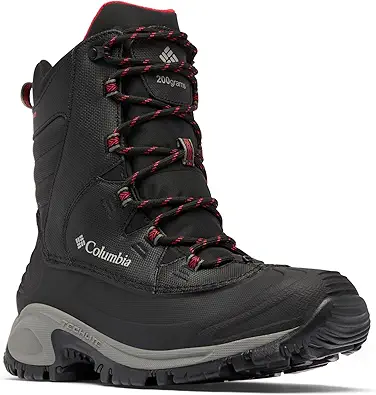
Columbia Bugaboot III
- Sub-$120 retail — best price-to-warmth on this list
- Omni-Heat reflective lining adds warmth without bulk
- 200g insulation handles moderate winter conditions
The Columbia Bugaboot III answers the question "what's the cheapest winter boot that won't fail you?" — reliably and without drama. 200g insulation handles moderate winter cold, Omni-Tech waterproofing keeps feet dry through standard winter conditions, 200g Omni-Heat reflective lining adds modest warmth without bulk, and the rubber outsole provides adequate (not great) traction on packed snow. 2.5 lbs per pair, sub-$120 retail.
Columbia's achievement with the Bugaboot III is matching mid-tier performance to a budget price without obvious compromise. The boot fits true to size, doesn't leak in standard conditions, and provides enough warmth for everyday winter use in climates where -10°F is the cold floor. The construction won't last 10+ years like a Sorel Caribou — plan for replacement every 4-5 winters of regular use — but at 1/3 the price, that's a defensible tradeoff.
The Bugaboot III isn't the right boot for serious cold (step up to the Kamik Nation Plus for better extreme-cold value), wet conditions (the Muck Boot Arctic Pro dominates that category), or active winter hiking (the The North Face Chilkat V 400 is better built for movement). For everyday moderate-cold winter use at the lowest reasonable price, the Bugaboot III is the answer.
Pros
- +Sub-$120 retail — best price-to-warmth on this list
- +Omni-Heat reflective lining adds warmth without bulk
- +200g insulation handles moderate winter conditions
- +2.5 lbs per pair — reasonable for active winter use
- +Excellent retail availability
Cons
- −Not warm enough for sustained sub -10°F use
- −4-5 year lifespan vs 10+ for premium pac boots
- −Outsole adequate but not ice-specialized
- −Sealed liner construction
The reliable budget winter boot. Hits the value floor without obvious compromise. Right for buyers who replace gear regularly rather than buying once for a decade.
Kamik Nation PlusBest Budget Extreme Cold Winter Boot
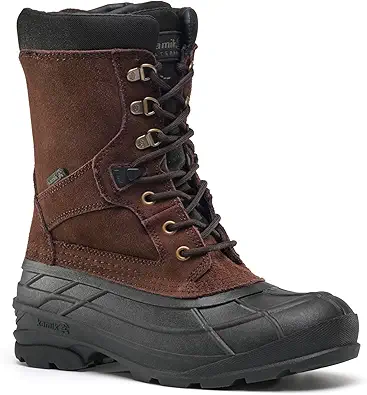
Kamik Nation Plus
- -40°F rated at sub-$80 retail
- Removable Thermal Guard liner extends boot lifespan
- Recycled materials throughout
The Kamik Nation Plus is rated to -40°F and costs under $80 — the most extreme-cold rating per dollar in this roundup. Removable Thermal Guard liner, waterproof upper, Canadian-made construction, recycled materials throughout, 3.1 lbs per pair. On paper, this matches the Sorel Caribou Boot at half the price.
The differences between the Nation Plus and the Caribou show up in materials and longevity rather than warmth performance. The synthetic upper isn't as durable as full-grain leather, the rubber lower isn't as thick, the outsole compounds aren't as ice-grippy. Plan for 4-5 winters of use vs 10-15 from the Caribou — but at half the price, the per-winter cost is equivalent.
The standout feature is Kamik's Canadian heritage — the brand has been making cold-weather footwear in Quebec since 1898, and the Nation Plus reflects that lineage. The recycled materials story matters for buyers who weigh environmental impact: the Nation Plus uses recycled liner fabric, recycled rubber, and is made in a facility that runs on hydroelectric power. For buyers who want the warmth of a Caribou at the price of a Bugaboot, the Nation Plus is the answer.
Pros
- +-40°F rated at sub-$80 retail
- +Removable Thermal Guard liner extends boot lifespan
- +Recycled materials throughout
- +Canadian-made (Quebec heritage)
- +Best extreme-cold value on this list
Cons
- −Synthetic upper less durable than leather
- −Outsole compound less ice-grippy than premium options
- −4-5 year lifespan vs 10+ for premium alternatives
- −Limited colorway selection
The budget extreme-cold winter boot. -40°F at sub-$80 is unmatched on this list — and the Canadian heritage is a real story, not marketing.
UGG Adirondack IIIBest Urban Winter Boot
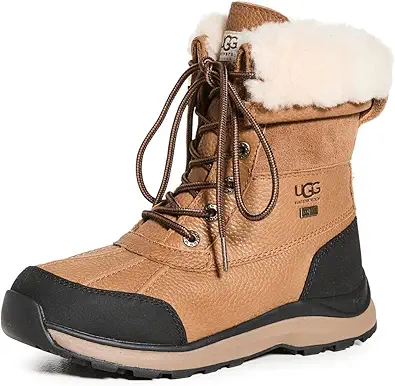
UGG Adirondack III
- UGGpure wool lining — variable insulation performance
- Waterproof leather upper
- -32°F rated for moderate-cold winter conditions
The UGG Adirondack III takes UGG's warmth reputation and puts it in a boot designed to walk through a city in January without looking like you're preparing for an expedition. Waterproof leather upper, UGGpure wool lining (genuinely shorn wool, not synthetic), -32°F rated through the combination of natural wool insulation and waterproof construction, Vibram outsole, 2.8 lbs per pair, women's sizing standard.
The UGGpure lining is the differentiator. Synthetic insulations (Heatseeker, Thinsulate, etc.) work by trapping air in synthetic fibers — effective but uniform. Natural wool varies its insulating performance with humidity and activity level: wicks moisture when feet sweat, retains warmth when feet are dry. For urban use where you transition between cold outdoor walks and warm indoor spaces (subways, offices, restaurants), the wool's variable performance matches your actual needs better than synthetic uniformity does.
At ~$220-280 retail the Adirondack III sits in the premium urban-style tier. For purely cold-weather performance the Sorel Caribou Boot outperforms at lower price; for wet conditions the Muck Boot Arctic Pro is purpose-built; for active winter the The North Face Chilkat V 400 is more capable. For style-forward urban winter use where wool lining and design matter alongside function, the UGG is the right choice.
Pros
- +UGGpure wool lining — variable insulation performance
- +Waterproof leather upper
- +-32°F rated for moderate-cold winter conditions
- +Vibram outsole for reasonable traction
- +Strong urban-style design language
Cons
- −Premium pricing reflects style positioning
- −Not warm enough for sustained sub -25°F
- −Sealed liner construction
- −UGG branding may feel non-technical to some buyers
The right winter boot for style-conscious buyers in moderate-cold climates. Wool lining and Vibram outsole deliver real performance under the design-forward presentation.
Questions Worth Asking
Common snow questions.
Related Guides